Ancestors or Tricksters? Understanding the Unquiet Voices w/Nonie and Rob Douglas


 Apple Podcasts

 Spotify

 RSS Feed

 Amazon Music

 Castbox

 Deezer

 Podcast Addict

 Podchaser

 JioSaavn

 Spreaker

 YouTube
In this episode, we’re joined by Rob and Nonie Douglas, authors of Unquiet Voices, a fascinating guide that blends classical necromancy with modern paranormal investigation. We explore the intersections of medieval magic and contemporary ghost hunting, dispel common misconceptions about spirits, and learn practical tools for navigating encounters with the unquiet voices that surround us. Whether you're a seasoned investigator or a curious newcomer, this conversation will challenge what you think you know about the dead—and the living who seek them.
About Guests:
Rob and Nonie Douglas have been studying the esoteric arts together for more than thirty years.
Become a supporter of this podcast: https://www.spreaker.com/podcast/paratruth-reborn--6273542/support.
Thanks for listening!
0:03 Welcome. Well, well do Para Truth. Truth What's going on? Peara Truthers, Welcome to another episode of Paratruth Radio. My name is Justin and I'm Eric. And tonight we are bringing on Rob and Nonnie Douglas to talk about their book Unquiet Voices, The Magical Art of Laying Ghosts. This will be an interesting conversation. Rob and Nonie have been studying the esoteric arts together for more than thirty years. And without further ado, let's bring in Rob and Noni. Rob and NONI, welcome to Paratruth Reborn.
1:12 How are you all. We're doing fine. Thank you great to be here. Yeah, thanks go Hovings. It's glad to finally get you od we you know, we were struggling. Yeare tons of term So something that we usually ask everybody is how did you get into the all things strange and unusual? It really started with me. I grew up in a very traditional family and always wanted to get involved in spirituality and magic and eventually got into it when I was eighteen years old. And from there people were interested in, you know, what's going on in their homes when things started to go bump in the night and so you know, they came to someone they thought knew about it. Okay.
2:02 Yeah, And for me, I met Rob when I was twenty one. We've been together ever since. So we've been together for thirty years working on this kind of thing. It's you know, ghosts and spirits and that sort of thing is really part and parcel of a study of magic and the occult. It's not necessarily our direct and only interest, but it definitely is something that sort of captured local interests. It's one of those practices that's immediate. You know, there's a lot of philosophy, a lot of individual practice in esoteric systems, but when someone faces something that's immediate in their life, this is the type of thing that you can engage in and it's right there. It's incredibly practical, I hope.
2:53 Well, Now, for listeners who are unfamiliar with your book, what does the title Unquiet Voices actually signify? Primarily that not all people who are deceased are ghosts? Okay, Ghosts tend to be those spirits that are stuck in between because of their attachments, so and they often reach out to try to communicate to us. So Unquiet Voices indicates that these souls that are that are bound by their own attachments are reaching out and they're around us all the time, and if we just take a moment to listen, we'll find them and be able to help them.
3:36 It's also a general term for just restless spirits, those spirits who are just not satisfied where they are, or they can't move on, or they sort of somewhere in between. Okay, now, can you tell us a little bit why you guys decided to write the book. Oh, actually, we did a presentation at an event and it was incredibly popular, which surprised us, and it kind of pulled us into the orbit of the publishers and that sort of thing. We ended up in a discussion and we ended up writing the book. It was never our intention to write an esoteric book at all in our lives. We're in our fifties and so it's not really the time to start when you want to set up a career as a nest other writer, what kind of reluctant authors.
4:23 Yeah, it really was something we felt needed to be said. There were enough, there was enough influence around us to sort of guide us towards this would be the right thing for us to do. We've always been very It's something we've held close to our chest. It's not something we've ever really talked publicly about, and so putting it into words and sharing it was it was a bit of a leap of faith whether there would be interest in this, but we were sure that there was. The publishers approached us and it sort of went from there. Well, there's always interest. I think it's just narrowing it down for sure. Yeah, And I would say that we we have a very particular kind of approach where we're crossing the lines between occultism and paranormal investigation.
5:14 We're not paranormal investigators ourselves, however, we've been present and invited to participate when things are a little bit beyond what a situation, when it might call for a little bit of specialized interest or expertise. Having said that, we did have done many, many of our own investigations in private homes and for people who are facing a spirit disturbance. But we have worked in the past with other paranormal investigators and seeing their methodology and had that team sort of dynamic. Okay, Well, now, so many people seem to believe that necromancy is kind of a negative term signifying raising the dead or having the dead do your bidding and things like that. Probably a lot of what movies kind of teach people. But what is your definition of necromancy and why should people not be afraid?
6:12 Well, necromancy simply means the art of working with the dead. Essentially, mantia means like divination or mantic speaking. But the term came to me sort of like in general, a specific esoteric art. Necromancy got its bad name from the machinations of the medieval church, and it got confused with another word, which means the black arts, and the two words became synonymous, and so it was the blackest and darkest of all arts, when in actual fact they were totally separate systems. Uh. Necromancy can be misused like any other magical form. But when it comes necrovanci is divided into two branchesanci and neciomancy.
7:03 All right. Neciomancy is where you're you're evoking spirits of the dead for various magical reasons. Skiomancy is when there's a disturbance and you go to the location and you resolve the disturbance. So h, the book's really about skiomancy neciomancy. The word necio is a latinization of an Old Greek word for the type of rituals when they were within a place that was a liminal place between the netherworld and our world, So in a temple called the necromantean in Epirus, or at a tomb, for instance, and there were a set of rituals that in Greek culture they performed, and it sort of bled into medieval magic from there.
7:49 Now, if there are any cautions that you would give people considering to practice macromancy, what would they be. I'd say it has to be founded in compassion and respect for the living and the dead. My main caution would be, don't jump into deep too fast. There's a lot of things that can go wrong when you're practicing these arts. And the biggest rule of thumb would probably be be logical. When people talk about esotericism and magic, they think it's like the antithesis of logic, but the reality is it's not. You need to be able to define what is caused by physical events, what is caused by emotional and mental issues, and what's caused by potentially caused by a spirit. And you have to know have certainty in your knowledge base in what you're doing, and so if you're prone to flights of fancy, then it's probably not for you because that will lead you down a very dangerous path.
8:59 Okay, So in terms of necromancy, I think another thing is just to kild yourself with information. It's a very misunderstood term when we use it. We really are talking about communication with the dead. Our particular strand of necromancy really comes from a cultural background in laying ghos, and so it's a service. It's not necessarily you know, it's not for entertainment. It's not for thrills. It's not for you know, the excitement and the adrenaline that some people get from it. For us, it means something where you are thinking, have a compassion approach and trying to resolve a situation which may involve the living and the dead and things just aren't going so well. You know, being able to get in the middle of that confrontation and resolve it in a way that creates a peaceful resolution is really the goal of what we're talking about a little bit different to what you find in popular.
9:59 Media popular media. Popular media likes to focus on the imagery and it boosts certain people's ego, but that's not what we're promoting. Right, Yeah, I mean, I think that's where most people's knowledge of necromancy comes from. So totally get it. We're incredibly boring, normal people. Yeah, we just sort of happened to live with one foot in this world and one foot among the world of spirits and the dead. And I think a lot of people do, and a lot of people are open to the idea, But it doesn't necessarily mean that when things start to go awry, when it crosses over and it's unwelcome, people don't know how to handle it or what to do, and they sometimes can immediately think that there's potential for danger sometimes there is, but learning how to analyze that and how to have a way of approaching it and almost a bit of a formula how to identify it it. Is it a problem? Isn't it a problem?
10:59 You know? How do we control the environment. We can't always control the spirit, we can't always control the situation, but there are things that we can control that mitigate it. And having a real understanding on how to navigate those unseen realms is really where our focus is. Okay, Okay, so that probably kind of lines up with my next question here, which is how does classical necromantic techniques complement or enhance modern paranormal investigation tools. I would say it's the other way around. There's so much experimentation and exploration and modern paranormal investigation, from the technology, to investigation techniques, to experiences that are recorded. A vast number of experiences that are recorded that can be analyzed.
11:49 The old methods are based on their knowledge base and a rational means of investigation, but we can enhance all of those old methods with a lot of the new methods when we test them and they become tried and true. For instance, everyone knows an EMP meter well, it helps. It helps to identify when there's em present, although to be honest, if you have experience, you can pretty much sense that there's a EMAT presents immediately walking into a location. But that was just one example. Yeah, I would say that when necromancy crosses and supplies a good foundation and a basive knowledge for modern investigators is really in the classifications. I think that it's really fundamental knowledge. It's it's a set of classifications that has been agreed upon and observed and worked for, you know, over two thousand years of recorded history in various ways, in various documents, and I think once we discovered that in some of the manuscripts and we're able to apply it to our own experiences and then see that it was consistent and that this is a working system. It happens in about chapter five of the book, and basically that piece of information, if that's the one thing that an investigator or an individual can take from our book,
13:22 that's knowledge worth sharing in our opinion, because if you can classify spirits, you can then understand what their motivation is. You can understand what potential there is for harm, but you can also communicate that with other people in a coherent and articulate way. It also helps in streamlining how you're going to proceed with your investigation and the cautions you need to take. Okay, now we've talked about the misconceptions about necromancy, but there are a lot of misconceptions about spirits. What they are. You know, you ghosts at the beginning are are completely different than spirits. What are some of the most common misconceptions about spirits that people have.
14:09 I think that there's a sort of sense of us and then and really it's more like like the global community expanded out into multiple worlds. So you have spirits that aren't human that we do interact with that turn up every now and again, and knowing them and knowing their nature is necessary when you're doing an investigation to be able to identify that this is not a ghost and therefore has to have other means to interact with it. When it comes to classifying human spirits, it's about it's really based on their behavior and the condition that they are in, read their attachments, and it's kind of psychological.
14:59 You have of a way of knowing or guessing how they're going to react by what classification they are, so that you can tailor your investigation to get the best effect, to find a resolution in the quickest and most efficient way. I think that one of the major misconceptions that is so easy to blow out of the water in popular media is just so you know some of the nature of manifestations and what they mean. When a spirit manifests into a space, it's because the conditions are right. It's not necessarily because they're trying to manifest, although sometimes that might be, but very often it's just that we're getting a little glimpse. We're sort of seeing the manifest you know.
15:43 Shadow figures are really just, you know, something that you might see at a stage of manifestation. It doesn't make them evil or dark or anything else. It's just that we're seeing a spirit in the condition most congruous to our. Visual We're talking about environmental factors that allow us a glimpse right on the edge of that veil. And sometimes that glimpse is a bright or b like structure. Sometimes that glimpse is a shadow. Sometimes that glimpse is a transparent apparition. They're not doing it, it's just the conditions are right for us to see just that much at that point in time.
16:30 So learning to tell the difference between those environmental factors and then what might be a sentient being, it's definitely one misconception. I think that another one is the nature of obsession and possession. A lot of times when people are getting into the realm of where they feel that there's some kind of otherworldly creature which might be affecting a person, it is the most likely thing is that it is a human spirit who has ill intent and learning how to deal with them, and it is more than possible to learn how to deal with them. We don't need to necessarily be frightened of them. We just need to kind of expand our understanding. And you know, people that on this side of the veil can be assholes, and they can be assholes on the other side of the vale ex fair enough.
17:22 Also, the most important thing to remember is regardless of the state that they are in and the attachment that they have, ghosts are people. They're no different ultimately and in their essential nature to any other human being. And if you can interact with people from all walks of life with all different attitudes, you can learn to do the same with ghosts that just have particular conditions unique to them. You know, one thing that really stands out to me here is you mentioning shadow people as being more of a process in terms of their ability to appear based on their environment. But we have seen for years now there are a large number of people who blue shadow people are separate entity from like human or anything else.
18:12 They're their own being. And of course that really lines up with what is known as the hat man, which is a settle person that a lot of people seem to have noticed, and they often say that they feel dread or they feel that a thick atmosphere is some sort of fear. Every time these entities are around. You stating that these are potentially just normal people who just happen to be able to appear as a shadow in that moment should really should basically contradict a lot of what these people feel. So how do you consider what these people are experiencing compared to what the likelihood is of the actual shadow.
18:56 It's not really a contradiction because a spirit, when it's manifesting, it doesn't have to be a human spirit. One of the phases of manifestation is a shadow. But when it is a human spirit, one of the signs that you're actually dealing with the human spirit is a sense of paranoia, being watched or fear. It has to do in our experience with sensitivity to EMM. It's one of the signs that the ancient magicians noted with regards to human spirits as opposed to other spirits. They have what they call signs and movements which help them identify what type of spirit you're dealing with. And it's not the spirit causing the fear necessarily it's part of how they manifest in the conditions of where they manifest. So any spirit that's in between what we call the meta cosmos that is a human spirit will come with those kinds of feelings.
19:52 The idea that shadow people are a unique type of spirit, I've never found any evidence to support that in all the years that we've done this. I do know that a spirit that is non human can also appear as a shadow. But when we look at the folkal or around shadow people, and you talk about the hat man, well, think of it this way. In their universe we now have milliners and an industry to create hats and so on and so forth. It seems more likely that they're going to be a human spirit with appearing wearing a hat than some unique, you know, demonic being that likes hats.
20:36 And you know, it's like like that with the Christian concept of a demon. I can see where they're going. But in my experience, or in our experience, I should say, it's usually human spirits that have ill intent that will try to scare people by implying that that's what they are. I've yet to come across anything that really fits the fiend of Hell bracket in any investigation I've done, and I've and you know, we've dealt with more than human spirits in our investigations. So as we said, we're pretty ordinary people, pretty practical, and I would have to see the evidence of that before I could say that shadow people are a specific branch of spirits or that there's demons out there that want to eat your face just because that's their nature. I haven't seen it at all, So I think that's that's for us. It has to it has to be something that we've come across, dealt with and talked by experience on.
21:37 So, so chew that in and just to summarize, so when it is a shadow person, the fact that there is a feeling of fear just confirms that they are human spirits. Okay, okay, And and that record goes back well over a thousand years. You know, the human body is the most receptive tool when it comes to detecting spirits. We have this inate ability to feel when a spirit, and especially a revenant spirit, like a spirit hasn't crossed over when they're present, you know, we feel afraid, we are our skin prickles, and we might feel cold. They're all signs that it's a human spirit that's present and.
22:21 They're well recorded signs. Now, you mentioned you guys have come across non human spirits. What other type of spirits have you come across? Probably the most common is what's known as terrestrial spirits. The people will call them nature spirits and stuff like that. They have multiple forms, so they can be scary when you come across them. And as we're talking about signs and movements earlier, one of the signs of terrestrial spirits is red eyes, not because they're evil or nasty, just that's something that you often see with them. And they're intensely curious. So especially when there's something going on a spirit disturbance and people turn up to investigate, or they they love when there's electronic stuff they've never seen before and stuff like that, and they will flood a space where one spirit is causing the disturbance, but now you're investigating and they'll start flooding the space. It's really common.
23:21 I remember in one case they were a paranormal team was looking for a specific entity that was that was obsessing a location and they turned the lights off and they took a flash of property and there was one orb that was clearly a human or because they're unique. They're very bright and alvalescent and have a blue corona around them and so on, and it was there and then they pulled out. They're pulling out all their equipment in the dark, and about five minutes later they take another photo and the room is filled with orcs, all irregular shapes and strange and wonderful. That's a good indication that Treshfold spirits are turning out well. They're incredibly, incredibly curious and a lot of hauntings are put down to them, and people don't realize they'll they will interact in your physical environment just because they're curious and interested. There's others.
24:16 There's aerial spirits and aqua spirits. These classifications go back to before the tenth century. They're not actually of the elements. They just use the elements to classify them, and later on they use planetary classifications. But there's numerous kinds of spirits that are constantly flicking in and out of our world, and we can we tend to interact with them, and they're unique to themselves and the world that they originate in. But one thing we do find consistently across all cultures is that there is a certain number of them, and the way that they've recorded them is usually about seven of them, and and the way that they classified the way they behave is consistent. In our book, we've tried to sort of take a bit of a universalist approach, drawing from ceremonial and medieval sources however you can find them. Also, we refer to Sellers, who was from He was.
25:18 A Greek Orthodox philosopher theologian, and he writes about dens from a great coosthration point of view and the classifications they use. Yeah, which is why we think it's a valuable tool, being able to sort of look at these classifications and then apply it to experience and sort of see where where it is. And there's always room for more experimentation. There's room for personal experience and way that that's interpreted. It's very hard to record what some of these experiences are, and so usually when when this knowledge gets passed on, it's usually gets passed on with some experiences or with some knowledge so that individuals can sort of see what that means for them because they experience of it might be unique.
26:06 Okay, now, So for people who are just starting out in say paranormal investigation, or just interested in the paranormal, what's the most important thing that they should know. I think building your knowledge base is primary. I mean knowledge is power, right, and when you go to an investigation, you want to know as much as you can about what's going on. The other thing is obviously things like protection and and a good investigative methodology so that you're safe and that you've got a logical process of what you're going through. All that's fantastic, but when it comes down to it, walking into a dynamic situation of a spirit disturbance without a solid knowledge base is going to set you at an incredible disadvantage from the beginning, and that is.
27:02 It's a little hard to develop. There hasn't been a good, trustworthy source. There's been a lot of good individuals who have shared some experiences, and there's been a lot of interesting theories about, you know, what things could be and things that work for people. And I guess what we wanted to supply here is something that could be a primer to introduce someone from what's going on in the invisible world through to how to identify something is harmful and then some methods of how to deal with it. It isn't something that is for everyone, but we do hope that, you know, adding a little bit of foundation to some of the investigations and studies, because as much as there is exciting and interesting things going on in popular media and in the experimentation that people do, there is this underlying foundation of knowledge that has been lost to most people, and so being able to sort of bring that forward into this century has been you know, we hope helpful for others. But in terms of what is most important, I think is to understand why you're doing it. Is to understand who you are, how you're going to protect yourself, who you are as an individual, and so that you can identify when an experience is outside of yourself or whether it's happening internally inside you, whether your reactions to the environment is your reaction to
28:34 a spirit. Do you have the knowledge and the skill to be able to communicate with a spirit if that's what you're trying to do, and then what are you going to do if things don't go your way? Now, you guys have been talking about knowledge for a little bit here, so I think this question kind of lines up with what you guys are talking about. In your view, what wisdom have we lost for the nechromatic practices that could help us better understand the paranormal today. We think about paranormal investigation over the last century and how quickly it's evolved, how much information has been gathered and experimentation has created new means and new pathways to find out more information. And that's only in one hundred years. Really, it's only in the last sixty odd years. So imagine the information that was collected by practical magicians doing this for two thousand years. That information doesn't change because we're living in the modern times, because the experience is the same.
29:39 That information is tried and true and tested over to millennium. That can give you a bulwark of information before you even step foot in an investigation. We're not saying one is right and one is wrong. We're saying that it's a continuum of information. Hopefully, another thousand years from now will be the blending of all the new paranormal research and the old will bring us to an even greater understanding. But at the moment, there's no reason that we can't inform ourselves from the past and understanding what's happening right now.
30:20 Do you think there's any modern research in the paranormal that kind of cancel out or belittles some of our past understanding, some of the ancient understanding of the paranormal. Yeah, absolutely, you know, I think that there's there's always room for that. And you know, we briefly mentioned the you know, the art of lango, so we don't talk about it a whole lot in the book, but it really is where this practice comes from. So it's a community service and it sort of fell to in Scotland at least it fell to ministers and other ordained individuals and elders who would be the person that you would call on who had the authority to deal with the spirit when they weren't listening. But that being said, there is a lot of a lot of interaction and a lot of interplay between the community and that individual and between the spirit world. And I think that one of the major things that we have lost is that connection where we start to think of the spirit world as outside of ourselves. We start to think of the belief in the spirit world as something that is irrational and somehow demeans us. If we have interactions with the spirit world, or that we have to question individuals who do and we have to question their sanity. No, I think that ultimately the natural relationship between the living and the dead, and also the community responsibility that we have both to the living and the dead, is one of the fundamental
31:52 reasons that many of the things that we've lost over time, and the knowledge that we've lost and the way that we will regain it is just by understanding that these things are integrated, they are continuous, they are part of our human experience, and when we deny this one part of our human experience, then we start to fear, We start to you know, not have the understanding that we could have to resolve ordinary things around us. History is also a number of schemes in a larger tapestry and its peaks and valleys to cross metaphors. So there are periods in history where we've lost so much information, and erroneous information has been promulgated and preferred information based on certain philosophies has spread. We focus kind of right on the cusp of the twelfth century Enlightenment, where the old magic was becoming more modern and mysticism was embraced the following century. Of course that was suppressed, but that period it's kind of like a golden Age where the period prior to it was there was a there was a full continuity of tradition leading up to that point, and we've sort of did use that as a jumping off point. But of course there are things that can be discovered that will either highlight something from the past
33:23 or say they got it wrong. For this reason. One good example of a highlight is the signs and movements of a human spirit, the costs where they cause fear or cold spots, which have both been confirmed numerous times in various paranormal investigations for the last sixty years and has become part of the urban folklore. So here's two experiences that are identical you have in the toss Entry Enlightenment. They're seen as signs of what a human spirit is, and they are the same things that people are experiencing today. So there is a continuity of experience because this isn't just philosophy, this is people experiencing real things, right.
34:10 I want to kind of follow up at that too, like what is so investigating the paranormal the whuoal idea of researching the paranormal and trying to learn about it is considered a pseudoscience. At what point do you think it merges with what is are you know, modern secular science? Because modern science denies the existence of the paranormal, while pseudoscientists who are very much scientists and in themselves who have evidence, say otherwise. And yet there's this constant butting of heads. Do you think that could ever be breached or why do you think there's such a such a do you think. It can be breached? There's a period of scientific rationalism that kicks off kind of nineteenth century ishue. You got to remember that most of the scientific principles or the things upon which science built was that actually from esotericism in the past. The idea of forming a hypothesis, a logical hypothesis, testing it, and when it's tried and proven to be repeatable, it becomes part of the system that that's been involved with magic since recorded history, so that the so called scientific method has been there the whole time.
35:22 You look at some of the great scientists in the Enlightenment period and and the Renaissance, and they were occultists. The idea that that spirituality and science are divorced is really a post Victorian idea. And there are plenty of scientists that are open minded. Science should be about having an open mind and testing, but there are those who don't, and and when they when they see science is only what can be measured in our universe, they missing everything else that could be out there. So so that the logger between the two types of scientists, I think, well that that curiosity and acceptance will ultimately win out. I think that the super rationalism will not last in the fields that are that are active at the moment. Who knows in the future. Because a lot of this is about philosophies. Scientists like to think they're not philosophical, but there as philosophical as anybody else. They have an opinion, they have a predisposition, and you know they're either trying to prove it or disprove it.
36:33 I think you have it much more a more positive approach than I do. Rob. I feel that you know, one day they might come together, but I think that it's a long standing narrative and it's going to take a lot to change that or to dispel either side. And I think that's enough room for all that contradiction. It's okay. It's okay that science can be what it is, and you know, parapsychology can find its own place, and magic gonccultism finds its own way. People have their own unique ways of the way they interact and discover through the universe. I don't think that there is necessarily one answer or that one is correct. All of them can be true.
37:14 The universe is multifaceted, giant, bigger than the one we know, and completely confusing, so there's room in it for every paradox you can imagine. I love that answer. Now, there's a lot of people that tend to want to open themselves up to communicating with spirits. In your guys opinion, what is a safe way to do that without opening themselves up to harmor deception. I think, first of all, know who you're talking to and who you want to open up to, and be certain of it. That's that's rule number one. Trans Mediumship is old. It goes back to ancient Greece. The Necromantean had their transmitis in it. So there are safe ways.
38:03 It depends on your methodology and where you learn to do it. There are safe ways. Same with you know, people who consider themselves empathic and other sensitives. There's ways to do it. The idea is to be as safe as possible when doing it and not to jump into early. I would just add to that, So if your question was about communicating with spirits and a way to start that build that skill. Protection is obviously very important, but I would also start working with trusted spirits. Start working with those ancestors, your grandmother who's passed, or spirits that you can trust, get familiar with them and start to develop a relationship before you ever try to communicate with a restless spirit or a ghost or a revenant spirit.
38:56 Because the difference is between how protected you are kind of need an ally, and you also need to develop your own skills and have trust in them. If you try to jump too much into the deep end, you'll never know for sure whether it's your own ability or whether you're hearing something external or whether it's internal. You have to kind of develop that skill, and it is a skill that can be learned. We put a couple of exercises in the book where people who are interested in communicating with spirit they can do that in a very logical way. There's many many ways that people do it for people do get training. The method that we've put in is something that's tried and tried and tested.
39:40 It's something that if you follow it and do it, it will definitely strengthen your ability to communicate with spirits. But like any training regime you put yourself through, you have to work at it. You can't look for shortcuts or try to explain away and excuse what you don't know so that you can get you can jump to the action. And the same advice applies to someone who has a natural ability learning how to control that ability, how to apply a protection when it's required, how to communicate at will, and to trust that communication also requires some kind of self discipline and training.
40:21 Right, and then it's and so the on top of that, it's not just simply training and learning, but once you've learned the skill, you need to continue to practice it so that it doesn't blow I'm rusty and you come better at it. Yeah, skills atrophy, skills kanatrophy. And also it's just it's learning how to be able to access the right state of mind to be able to do it. It's just like you know, you know, if you if you were learning how to track and hunt. You would have to develop those skills particular to the activity you were trying to do. This is no different you or if you had to learn how to study to get through an academic schedule. You have to all those skills. You get better at it the more you do it. If it's been a long time, I could not imagine taking a math test right now. That would just be terrifying, But you know there was a time where that would be a pretty natural thing for me to do.
41:12 Also, you have to understand that there's trans Mediumship isn't just about talking to ghosts. Most spiritualists and spiritualist based systems work on talking to what's called the laries. They're the ones that are not traumatized and stuck in between. They're the ones who've moved on and are have made it to the other side, whatever conception of the other side you have, and they're freed up from their attachments and they're helping out. There's a big difference between spirit guides who are laris and trying to interact with a spirit that's traumatized and stuck because of their attachments, which may be angry or upset or confused, and so it's a different type of communication and one that you have to be much more cast yourself.
42:02 But in both cases, building a relationship with Alari's spirit is always going to be more beneficial because they can help guide you through those out of processes. Okay, now, Rob, you mentioned know who you're talking to. How can we tell what is good what is bad? Or those definitions are very obscure. I think, how can you tell who you're talking to? Yeah, this is a broad subject because first of all, you have to identify that there is actually a spirit there. There's a lot of things that can look like an obsession or home thing. When you've identified that it is actually a human spirit that's disturbing a location, you're then looking at trying to identify aspects of who it is.
42:55 So a lot of research goes into that if someone's seen them, you might take note of their clothing and attire and try and guess a time period that There's a whole bunch of things that an investigation you to do to try and narrow down who that person might be. When you actually begin communicating with them, you only have a short time to communicate with them, so don't waste time asking ridiculous questions that are not germane to the resolution you're looking for, because you won't have a lot of time. But when you are communicating with him, you want to steer away from yes and no questions. You want to steer away from giving them any information that they can repeat back to you or embroider upon to make themselves seem like there's someone that they're not. You have to be very disciplined in the way that you approach the communication. What in magic is referred to as the interrogatio, So you want to be able. You want to basically prepare a list of questions that you're going to ask, and then once you finally get the answer, and you may be certain it's the person you're talking to, you may think it might not be, or you're not sure.
44:02 The answers that you receive have to go through an analysis with other evidence to back them up. You don't take anything at face value, because an investigation is going to collect a mountain of data, and that data is going to come down to evidence, and that evidence has to be analyzed to create the picture of what is actually going on. And deception is a tool that some spirits will use, so you have to go in with us the knowledge you might be being deceived at that point. Mind you, deception is something human beings do too, because we've all walked into a case where the situation was a hoax. So it's not you know, it's not exclusive to ghosts.
44:44 Oh absolutely, I agree. Well, Now, speaking of cases, after about thirty years of research and experience, for you, like, are there any cases or encounters that have stood out or are particularly meaningful or surprising even. Oh, that's a really difficult question. For one thing, that there's such a vast variety of experiences. I don't think you could choose just one. Secondly, we try to be discreet. We don't show photographs of any investigation we've done of a location or the people involved. We talk in general terms, but I think emotionally one that and we were asked this question recently and answered the same thing. Emotionally. There was one we had where it was the spirit of a young boy who had been around for a little while in a particular area.
45:37 He had died of exposure in the mountains, and he was he thought he was going to get in trouble because his mother would be angry that he didn't have his cardiganism and that was why he wasn't open to seeing her or guidance to move over. And we were there in the resolution and helped him to see her. And it was an incredibly in mode of experience that choked us both up and we still think about it today. A lot of the most powerful experiences are really the most simple ones. It's very often for us it's a resolution for the spirit where they just kind of go, oh, you mean, I can move on, I can go, you know, And they often are the ones that have been most numerous.
46:23 It's very often the case where they really just don't have a real interest in the people that are there. They just kind of want to finish whatever unresolved if issue or task. Sometimes it was you know, a lady who left that she wanted to make sure her brother got the will she left in the drawer because she was a bit worried that, you know, the inheritance wasn't going to go to the right person. You know, these are very kind of simple and unusual things that really are a big concern to somebody in the spirit world. The ones they resolved, they move on very quickly. If you're asking about dangerous or exciting or yeah, powerful phenomenon we've seen. We've come across that too. I've been knocked over, pushed, punched, things thrown at me, all that that has happened. But they're not the things that stand out to me the most. It's the emotional, the powerfully emotional experiences that we've come across, so I think stand out the most.
47:28 Perhaps one of our experiences that is a little bit different to someone who's coming from the point of view of a paranormal investigator is that we're looking for if there's a magical influence as well, and so if there's kind of you know, residual manifestation, or if people have been dabbling in magic and they've kind of created something, or or if there's an incidence of what we call soul loss where individuals kind of manifest phantasms from them cells that can be apparent and appear to other people. So, you know, and very often that's the point where we're asked to participate in something, is where something has gone and it can't be explained by regular haunting, and so we're really looking at kind of what other factors could be at play that might have some kind of occult or magical basis to it.
48:24 Going back for a second to the simple answer, the vast majority of cases will come down to something that you would probably think you wouldn't hold on to, like why is that the attachment? But there's a change in cognition when someone immediately after physical demise, and what they're holding on to might seem irrelevant to the investigator, but is the lynchpin of reconciling their confusion. And so you have to be aware that not everything is dramatic. Times the most simple answer will yield the greatest results. And there's many times where this solution is for everyone to just peaceably coexist.
49:13 Now, there's so much information in this book. What is your hope that readers take from on quiet Voices? I think you said it. There's a lot of information in it, don't We never intended to be a book that you read and then put back on your shelf. It's something that we're hoping someone who's actively involved in investigation will come back to read and try to grasp or see in it something that they've experienced to empower their own knowledge base. It's easy to tell someone this is happening for this reason, but they don't get it often until they experience it. So the first time you read the book, you might not grasp some of the nuance in it until you've walked into a room and felt that dense, heavy feeling, or where you've identified where something is emf sensitivity, or where you've dealt with a spirit that has a particular obsession, whatever it is, and then you come back to the book and then suddenly it pops back out at you that this is what this is talking about. I just had that experience, And we're hoping that the book is something that people will return to like a manual more than a casual read.
50:27 Yeah, we originally hoped it would be more like a field guide for those people who are trying to resolve a situation, not just experience it for themselves. So our hope is that we have provided enough tools that people who really want to take this on can resolve a situation and not just go, yep, you're haunted. That's great, and move on to the next experience for themselves, but to actually sort of bring some peace to this situation that they're dealing with. And I think that a main motivation for us is you know, we come from tradition and culture that has been very rich, but we've also had to fill in a lot of gaps, and we would love if, you know, there was just a handful out there who could see that around in their own culture, their own their own traditions, and see that there is information out there. And we've tried to put it in a very universalist sort of way so that people can apply it to their own faith, their own religion, their own experiences, or their own culture.
51:34 Because it's an objective experience fundamentally. Okay, well, now, in your opinion, is there a type of individual that should resist from necromancy and why would that be? I think that would be like saying, is there a type of person who shouldn't be a firefighters. There's potential danger in necromancy, So anyone who's unable to have a professional detachment to or who is obviously maybe suffering from delusion or things like that should stay away from it.
52:16 But necromancy has been part of the human experience in every culture, in every part of the globe. And as none was saying earlier, community and the community of the dead have always lived symbiotically and in our modern age, we don't even see the animals we kill to eat. We buy them wrapped in cellophane in a shop. So there's this disconnect with not only physical death, but the community of the dead, and that's not healthy for the community of the living. And ultimately, I think that anyone who is motivated by compassion and by the desire to help others who are who are experiencing something that can seem quite traumatic, anyone who's moved by that can do this work. It's it's not reserved for you know, Gandalf or something like that. It's it's something that happens in every community. There are people in traditional communities here in the United States, say in the Appalachian Mountains or in the Ozarks, that know this sort of stuff and are the people that people will turn to when they're when they're facing it. There's just fewer and further between today than there was in the past. And that's more about society not including it in its sense of self.
53:48 Yeah, and just to divide your question a little, so in necromancy, communicating with the dead is really something that you know, making that connection with life after death or those who are around us who have passed on. You know, we hope that everybody starts to make that connection if they don't have it in their lives already. When we're talking about the practice of skiamancy actually being on location where there is a restless spirit causing a haunting, then we do make some suggestions about the type of person that you know is better to remove from the situation. That includes children, a woman who's pregnant. If someone is it's in some way emotionally or mentally at risk, or has been possessed or obsessed in the past and doesn't have control of that situation or very good protection, they are not good people to have when you're trying to undergo an investigation or where you feel that there may be harm from a spirit that could be caused.
54:54 Also health conditions like anxiety, heart conditions, severe asthma, hyperventilation, that sort of stuff. If people have physical conditions that can be exasperated by the events that are occurring, it's better to remove them from the investigation if you can. We also have a tradition around people who are excessively hemorrhaging or bleeding because it does attract it attracts spirits to what we call pasma that is surrounding it. You know, it's kind of like a free feast. So individuals, individuals who are suffering some kind of physical trauma, mental or emotional at risk, have a child in utero, or some other reason why they do not have control between or separation between themselves and the spirit world, they really shouldn't be participating in an investigation.
55:54 And someone who's being targeted for a spirit by severe oppression is not someone to wave as bait. They should be removed away from a location where they're being targeted. If the spirit fallows them, which can happen because they're they're fixations upon them, that might be a different situation. You might need to put some protections in place. But if the spirit is related to a location and they're oppressing someone in the location, best to remove the person from a location if that helps. Yeah, while the investigation, I definitely get on board with that. I think I've I've heard too many stories of people who use individuals as bait who are suffering from oppression, and you know, the investigators end up leaving the home and things are just worse for that individual. It's just sad.
56:46 It's kind of like the situation with using sage stage. What sage does is it makes it the conditions very hard for spirit to interact with our physical world. But the effects of sayage only lasts about two to three weeks. You'll if you watch a lot of paranormal shows I'm sure you guys do, you'll note that oftentimes I'll say, oh, you know, two or three weeks after the investigators sage the house and cleansed date, it all came back again. Because sage doesn't remove a spirit, It only, you know, changes the environments of spirit has less opportunity to act. You would need to do something more after.
57:27 That or continuously use sage to mitigate the situation. And you know, that's the kind of knowledge that that goes a long way for investigators to know because there's a lot of you know, this can be solved in this particular way in our experience. There's no one way to resolve or reconcile an obsession and a location, because it's as different as trying to deal with different people are ghosts are people, and they unique, and every investigation is unique, and the answer isn't always good. There's no one packaged answer you can use the reconciliation is always going to be tailored to the events and the attachments of the spirit that you're working with, if that makes sense.
58:17 Yeah, and we heard that that comes across in the book. What we're trying to offer is a process of working. We're trying to offer, you know, some rules of engagement of how to go about things, but that the actual situation, you really do have to approach each one as it comes. All right, Well, and I appreciate you all bringing that up, because I mean, I think Eric can attest to this. When we first started doing paranoral investigation, I think one of the things that was kind of ingrained in us, mostly because of you know, paranoral shows and stuff like that, is to cleanse the house, you know, stage and tell the spirit leave and stuff like that. But like you guys are mentioning, it's somewhat more complex than just doing one of those specific things.
59:10 Although one staging may work if a spirit is active in a location and for two or three weeks can't be active, they just might move on. But the thing with some forms of exorcism and moving spirits on is if the spirit is dangerous and it's you know, the obsession is turning towards an oppression. If you just move it on, it's going to do it to someone else. You have to have a means of returning the spirit to the metacausist and binding it from coming back. Otherwise, if it's affecting a particular family and you've succeeded in getting rid of it, down the street, another family is going to start getting affected by it.
59:51 And that is a case that we've seen in the past where you know, in a obsessive spirit just moves from one individual to another individual, to another individual to another individual. If unless you know how to kind of like resolve that or you know, very often you may not know, you may not know that that's the case or what's happening. And so having the ability to be able to kind of ask the right questions or see what's going on. And I'm sure you might have seen this kind of thing in your investigations, is that you know, you think you might have resolved something, but then all of a sudden it's turning up somewhere else, maybe even within the same location or. The same group of people.
1:00:31 Yeah, for sure, all right, it is about that time to let you guys go. So I want to give you the chance to tell where people can find you find your books that Mike's all yours. Oh great. So we are published through Llewellyn will Buy public publications. You can find our book on Quiet Voices, The Magical Art of Laying Ghosts. It's available on Amazon on good Reads. We love it when you leave a positive review. We just love that. We do have a website it is Arcane Borders all one word dot com and an Instagram account which you can follow, which is Arcane dot Borders. Yeah, we're struggling a little bit to keep up with everything. We're just sort of surviving through the hurricane Halleen at the moment and getting back on our feet. But you know, we certainly do try to keep it up today.
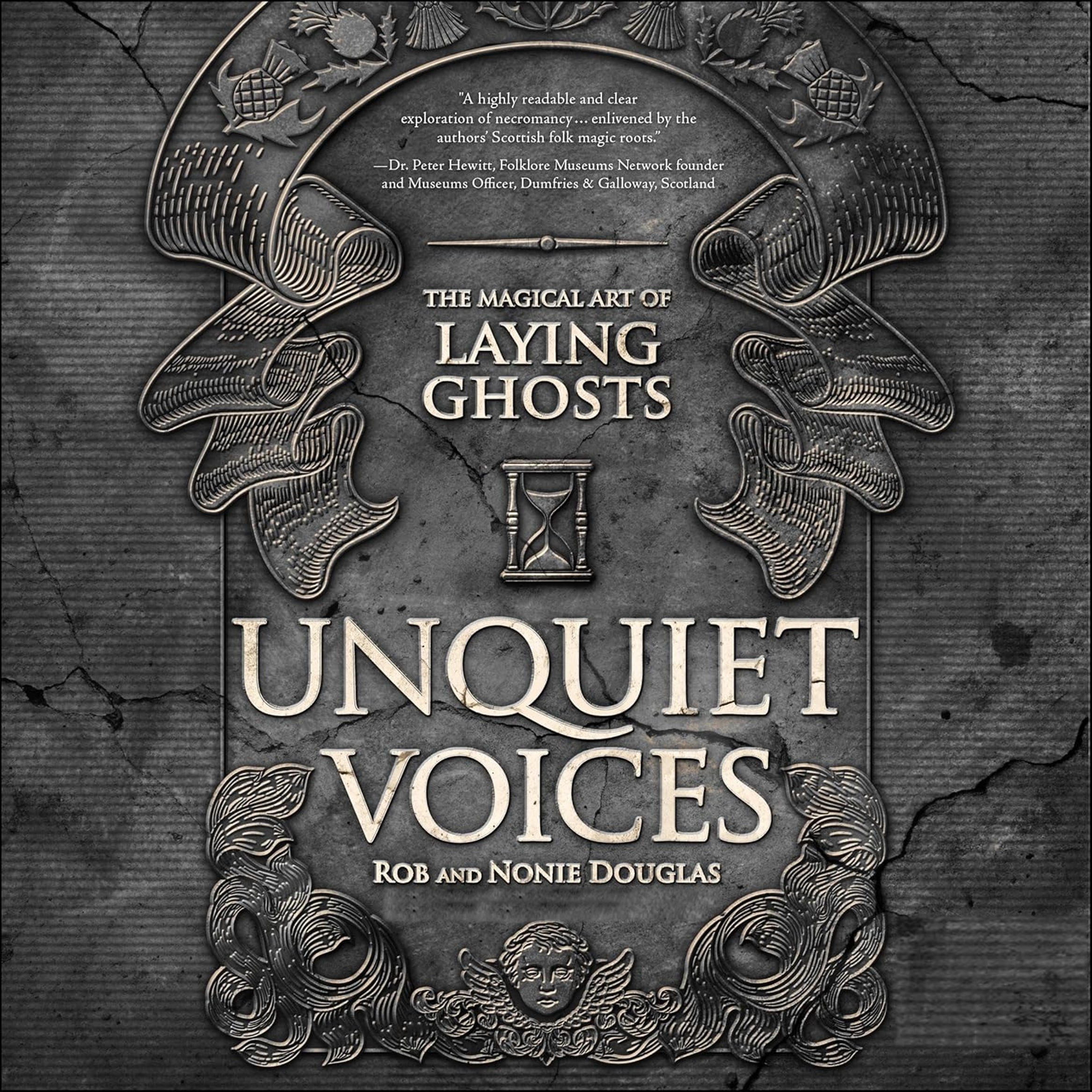
1:01:27 All right, all right, I'm gonna put you in limbo for a second so we can finish out the show and then we'll bring you back in to give you more information. So hold on for me, right all right, absolutely, all right, folks, I hope that you've enjoyed listening to Rob and Nonie Ducklow's talk about their book on Cuiet Voices, The Magical Art of Laying Ghosts. There is the cover for you if you're watching video. I think we say this way too often. The year has already. Been flying by. And next week is our Easter episode, so we're gonna have some fun with that. It's gonna be entitled The Magic of Easter, and then it's gonna be a couple of episodes of just Us before we bring more guests on, because we've got some topics that we want to talk about that I don't think I can find any books on.
1:02:20 So make sure you like, share, subscribe. No matter where you listen, make sure you check out all of the shows that are on United Radio, United Public Radio Network, and this has been a preer recorder show for one of some points on FM New Orleans and United Public Radio Network until next week, folks, where you will find us the same time, same channel. My name is Justin and I'm Eric Pace.