Before Santa: The Deities & Creatures of Christmas
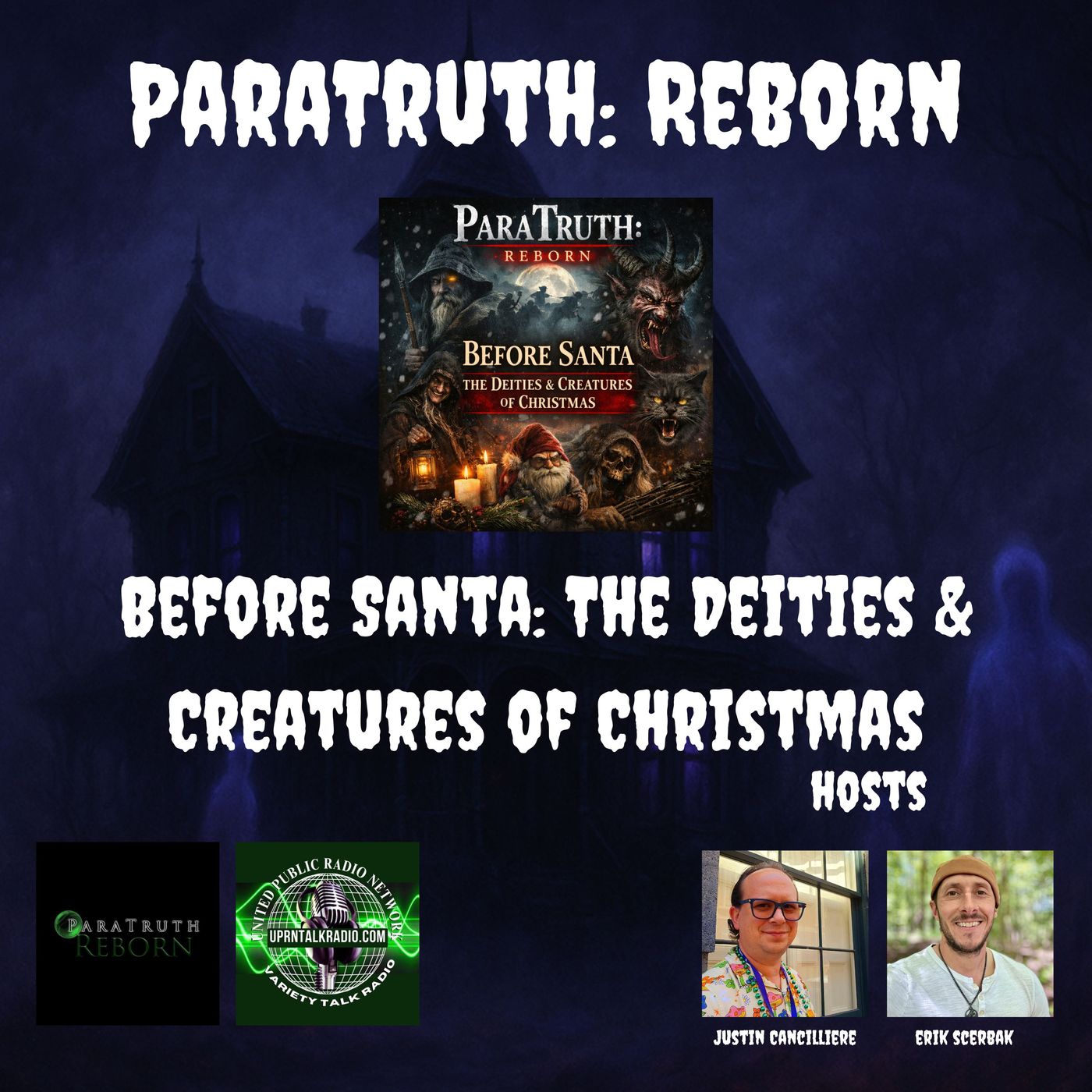
Christmas didn’t always belong to Santa Claus. Long before stockings and sleigh bells, the darkest days of winter were ruled by ancient gods, roaming spirits, and creatures meant to reward—or punish—the living. Yule was a season of survival, magic,...

 Apple Podcasts

 Spotify

 RSS Feed

 Amazon Music

 Castbox

 Deezer

 Podcast Addict

 Podchaser

 JioSaavn

 Spreaker

 YouTube
Christmas didn’t always belong to Santa Claus.
Long before stockings and sleigh bells, the darkest days of winter were ruled by ancient gods, roaming spirits, and creatures meant to reward—or punish—the living. Yule was a season of survival, magic, and fear… and many of those old beliefs still echo in modern Christmas traditions.
In this special Christmas episode of ParaTruth: Reborn, Justin & Erik explore the forgotten side of the holiday season—diving into Yule deities, pagan gods, and legendary creatures tied to Christmas across cultures. From benevolent gift-givers to terrifying watchers in the night, this is the side of Christmas most people never hear about.
Because before Christmas was cheerful… it was powerful.
Become a supporter of this podcast: https://www.spreaker.com/podcast/paratruth-reborn--6273542/support.
Thanks for listening!
0:00 Before Santa watched children something else did long before Christmas. Trees and stockings, winter belonged to gods who judged, spirits who wandered, and creatures that punish the wicked. Tonight we stripped Christmas down to his ancient roots, when Yu'll ruled the darkest nights and fear was part of the celebration. This is Christmas before Santa. Welcome to Paratruth Reborn, the Christmas edition.
0:55 God, I love that intro. Welcome everybody to another episode of Paratruth Reborn. My name is Justin and I'm Eric. Tonight, we want to give a special shout out, of course, to our friend a cat Ward and her incredible show Paranormal Heart. You can join her every Tuesday evening at six pm Eastern Standard Time as she delves into the world of the paranormal with guests from around at the world. Earlier tonight, we joined her for her annual Christmas episode titled Haunted Christmas Gifts and Creepy Traditions from around the World with yours truly, So if you list it, make sure you check out the archive here, on EPRN and everywhere you find your favorite podcasts. We'll also have a link to that specific episode in the comment section below.
1:45 All Right, folks, tonight we are talking Yule gods, and of course getting into some of the stuff we've gotten to in the past, like crampis perked, the Yule cat, all those great creatures. We talked about this a couple of weeks ago about talked about Yule and what it was, the traditions there. Now Yule will kind of do a brief over here. The ancient German Germanic Norse winter Solstice festival celebrating the sun's rebirth and Christmas, the Christian holiday for Jesus' birth, overlapped significantly as Christianity absorbed Yuele traditions to ease conversion, resulting ensured customs like the Yule log, which is now kind of a cake or more of a decoration than actually burning it, you know. Evergreen decorations like the Christmas tree and the wreaths, even holly and mistletoe, I believe cave for Mule feasting, gift giving, and festive lights all reinterpreted with Christian symbolism of light and new life.
2:56 Around the December twenty fifth date, Christian mission placed Christmas on December twenty fifth, although that of course has been speculated that that wasn't even close to Jesus' birthday, but they repurposed it to the twenty fifth to coincide with Fuele and making conversation or I'm sorry conversion easier to blending festivals. Now the different symbols that were reinterpreted into Christmas. Like I mentioned earlier, the Yule log became the Christmas cake or the Christmas log, first representing Christ the light of the world. Evergreens, trees and wreaths symbolizes eternal life in Christ. Feasting gives I'm sorry feasting or gifts continued now tied to the biblical stories and charity. The Yule goat, which I don't know that we ever went over. They were made out of straw. Figures became a companion counterpart to Santa Maybe where the Reindeers came from, and Odin evolved into figures like Father Christmas and Santa Claus. Today's Christmas incorporates many of these Yule elements, allowing for a blend of Pagan and Christian traditions, from the festive tree to the Yule log cake, marking a deep historical continuity.
4:27 In winter celebrations Winter Solstice as a time of fear, death and rebirth. But the winter soice is you know, obviously we've talked about this a couple of times over this past month, and the winter solstice is something that is very similarly. Tied to the autumn soe. Right. So back in Halloween we celebrate the same thayous idi of fair death of birth is when the sosif begins. But the winter so justice. He is a bit different because we're talking about a frozen time. You know, at least it's represented as the frozen time.
5:08 It's when everything ice is over, everything dies, Everything that you consider beauty, right is now kind of luckily shedding its leaves and flowers and whatnot. Right. So, one thing I do want to mention though, before we go on here or before I continue on here, regarding Jesus' birthday on December twenty fifth, or right, it isn't. There is a lot of speculation that Jesus wasn't actually born around December, right. Instead, it's more likely that he is born around springtime. We're talking somewhere between March and May, often falling somewhere within April. Which as you know, is usually willing to celebrate Easter, and because of that we couldn't really Christianity couldn't really I actually has a Christianity about Christians didn't really want to coincide it to very important aspects of Christ in the same month is birth but also his death. So taking the opportunity to shift it back to December right around Mule time to help bridge the gap between the Christian faith and the faiths of all primarily Norse brief system, they were able to kind of connect with those people and help share the story of Christ through elements that they had already known and cherished, and were able to hance create what we know today as modern Christmas, which celebates Christ. But yeah, so there is a little gap between when Jesus's actual
6:40 birth there was versus when where it currently is held as a as a holiday. Now regarding the Mule or the winter Solstice, the winter solstice is really the longest night of the year. Is symbolize fear, death and rebirth as the sun dies before its rebirth, representing a natural cycle of ending and new beginnings. Now a time for letting go of the old bitch is in this case fear, habits, or even grief, and to make way for growth, renewal and planting seeds for the future. It's seen across cultures in rituals like the yulogue or happy Soil ceremonies, reflecting a universal theme of transformation from darkness to light.
7:38 Now, one thing that is really. Intriguing. This is why we consider this an important day in terms of a solism, because the socius being the longest night of the year, the very next day, the very next night actually ends up being shorter than the night prior, and so is the case every night going forward until the summer solstice. Right, so now we're geting more time, more light every single day until the summer solstice, which happens obviously in the summer. And so that's the idea of light being rebirthed, or the sun being rebirthed. Now, in terms of fear and darkness or the death phase, well, we'll little deeper into this. The sun's fading in particular, it's this deep darkness of the solstice which evokes prime fears, often mirroring narrowing ancient anxieties about the world ending or light disappearing forever, as once seen in Adam's Fear of the first sunset. Now what is Adam's fear of the first sunset? Well, the story of Adam's Fear states that upon the first setting of the sun, Adam thought the world was ending due to his sin of eating the fruit of tree of good and evil, which brought him anxiety and fear, and therefore led him into a knight, a fasting in prayer, upon which, as the sun rose the following day, Adam believed it was due to his repentance.
9:05 But the story itself, however, isn't biblical, but instead is actually an idea formed through extra biblical traditions, in this case a rich theme from Jewish midrash, which is basically an interpretive story, and we see this a lot in many accounts throughout scriptures too, but in primarily we're talking about the Apocrapha. So these are stories that exist outside of the Bible itself and are deemed as being incredible, as being literal pieces of the Lord's word, and that there's all kinds of different nuances as to why those were children as apokrapha and not included in the Book of the Bible, which at one point some of these apocrapha were. The Catholic Bible in particular still hold some of these apocrypha, or most of them within the book itself, but they're still separated from the initial sixty sixth books. Now, another thing that we consider here is the mythological fears.
10:05 Some traditions associate the solstice with chaos, like the sea monster Leviathan, which I'm sure many of you know of, or even spectral figures like Odin's Wild Hunt representing the forces of winter and the unknown. And then there's this idea of internal darkness. But afore pre speaking, of course, this is the time to face personal shadows, grief, doubts, and fears, acknowledging them as a necessary part of the cycle. And this is something that we start to see in mentalism, right, so we started to see this in psychology, of this idea of shadow work. Who look within ourselves and try to correlate our mistroubles are troubles with the seasons itself.
10:58 So as we go through the water is we take the time to reflect on the things that are negative or dark about ourselves. And then as the light increases every day, we spend those days learning to rebirth from those difficulties or those troubles, thee the doubt that is, et cetera, and becomes stronger. Now on the flip side, there is rebirth and renewal, and this is where the return of light exists. And this is everything happens after the solstice. Now the sun's we turn. In particular is the saustice marks the turning point when the sun begins its return, symbolizing hope and the promise that light will always conquer darkness. Right, so we've seen for a law here that darkness was kind of kind of holding the sun, the light down. It was it was winding for a law there. But here we're seeing the sun come back and start to conquer conquer the dark. And typically the light stands against the dark much longer than the dark stands over the light. So when we talk about the seasons are parent where you live within the world, I suppose that's probably a little different if you're further north or south. And then there's a cycle of transformation, and it's a powerful reminder that endings like the death of the older year creates space for new life, such as rebirth of the new year. Much like seeds dormant in winter, and this is where we get the idea of New Year's resolutions, that idea to birth something new of ourselves.
12:33 And then we have rituals of renewal and cultures. There are a number of cultures that perform ceremonies like lighting fires or singing or even feasting to welcome the new turning light and plant intensions for the coming year, focusing on spiritual rebirth and a new authentic name. So this is something that we strive to renew and then keep that right. We want to keep that in all authentic life with us, not just you know, wear it for a couple of weeks or a year or whatever and throw it away. No, we want to use this opportunity to build something with you and hold on to it. It's supposed to be a change for the better. Now, when it comes to connecting fear, death and rebirth is very simple and yet intricate. The first thing you want to do is embrace the whole. The Socice teaches us that darkness and light, death and rebirth are inseparable parts of a single sacred whole. We're talking about a balance, right, We're talking about the yin and the yang. On top of that, we honor sacrifice because this is a time in which we release burdens, old cells and things that no longer serve us, hence death and sacrifice to be reborn into a more authentic life. And then, of course there's nature's mirror, the natural world cycle of doormance and resurgence, which provides a blueprint for personal and spiritual renewal because
14:06 we can literally see everything around us dying and reburthen season after season. Now, I mean I asked myself this. I'm sure you guys are probably asking, you know, why did darkness matter more than light back then? Because we do still cherish the light now, But back then there was a reason for these traditions. Darkness mattered more at the winter solstice because it represented the year's deep rest, a necessary period of reflection, revitalation, and nurturing new beginnings, making the eventual return of light a powerful symbol of rebirth, hope, and life's cyclical victory over dormancy, with ancient cultures seeing it as a second I'm for inner work, acknowledging for independence of light and shadow, and it does make sense why that Christ became the light during this time because we were already selling celebrating this type of thing going on in other cultures.
15:26 Right, hope, I have a bunch of buttons and now, but you get messed up. I'm sorry. I just wanted to give a quick shout to the common historian. Thank you for being here and watching today. All right, please continue. Yeah, So now we're going to talk a little bit about the mule and winter deities. And this is something that we were back and forth about discussing this month, but we actually put it to a poll and had quite a few of you respond wanted to hear more about the winter deities this time around, so we figured one out for the Christmas episode. Right, So let's begin first and foremost with probably the most famous figure in Norse mythology. His name is, of course, odin the Norse Allfather.
16:26 He basically heavily influenced Santa Clause, particularly through his midwinter role leading the chaotic wild hunt, observing mankind via his ravens much like Santa's elves or spies do, and even riding a horse known as Sleipner, who while also rewarding and punishing people with treats and abductions and being called the Yule Father. Now these ancient myths merged with Saint Nicholas traditions, softening Odin's fearsome hunt into Santa claus cheerful gift giving, creating the modern year known for winter journeys, a beard, and watching children. Now, for those of you who don't know, Saint Nicholas obviously isn't just a figurative word hearing his fictional character in the sense of Santa Claus, he is. But Saint Nicholas is actually or was actually a Christian, a bishop who often gifted children with a bunch of little gifts. So Christianity ended up bringing him into the mix to kind of trade off Odin. Now there's also frig which is the powerful Norse queen of the gods, wife of Odin, representing the heart of the home family and the motherhood, overseeing marriage, childbirth, and domestic harmony,
17:57 while also embodying deep wisdom oresight because she knows fate but doesn't speak it, and protection, especially for children, linking her to the quiet strength of the heart, the winter, survival, and the weaving of destiny. Her essence is in nurturing, in her strength and the guiding fate through quiet influence, much like the steady wont of a heart. Now, there's a lot of other gods, but I love that it brought up Boulder because he was one of my favorite Norse gods when I learned about the Norse gods.
18:40 Baldersmith centered on his death by mistletoe and eventual rebirth strongly mirrors Winter Solstice themes of death in other words, the darkest day and rebirth the return of light or the sun, linking him to Yule, the Norse festival of light and renewal, where bonfires and trees symbolized hope for the Sun's return and connecting Balder, god of light, to the year's cyclical death and rebirth much like a sun god. If I have to say cyclical one more time during this, I might get tongue tied. The holly King and oak King are symbolic figures in Pagan traditions, representing the eternal cycle of light and darkness, life and death ruling for half the year, each battling at the solstices for dominance and embodying nature's seasonal changes as the wheel turns. I was trying to remember there is a Christmas Claymation movie that came out when we were younger. Do you remember the name of it, but it had it. They weren't called the Holly King and the Oak King, but it was like mister Frost and yeah, that's what those were supposed to represent, was these two characters.
20:07 Here you got the reddon drinking. Was it? I thought it was a separate I don't know. It was Rudolph Shiny New Year possibly, but either way it was a Rudolph. Okay, I thought it was a different one altogether. I don't believe so. But the Old King light Growth rains from winter solstice Yule to summer solstice Litha, where he's defeated by the returning Holly King, Dark and rest, who rules until You'll when the o King is reborn, ensuring the perpetual return of light and life after darkness. Now sacrifice offerings and fear versus comfort during this time. One thing that you really see this in is in a lot of the You'll got and traditions, And we'll talk about this when we get into crampus and perka and stuff. In this day and age, we don't see the at least the fear versus the comfort. We talked about this on cat show that you know, in today's day and age, they're actually really trying to eliminate Santa altogether because it's lying to your children, right. And on top of that, Santa used to I don't know if those that still use Santa say that, oh, you're gonna get colon your stocking
21:39 instead of presence, which would have been a punishment or fear of punishment at the time. Now, how do you think the gods became more symbolic instead of worship the old gods specifically? I mean, I think it's just, you know, a change of culture, you know, like we said earlier in the show, as I mean, starting first and foremost when we talk about religion, right, we had the Christian faith kind of move in and start to mend some of its beliefs along with Norse beliefs to create the Christmas story in this case, or at least to help adapt to the Christmas story. Right. So again, Christianity at the time was trying to build a bridge to the Norse people, those who believed in the Norse gods, and they did that through the birth of Jesus because there were a lot of similarities in terms of the elements that were used during this time, and so we see a lot of correlation between them, and it's what helped bridge that gap and bring people of the Norse belief system into the Christian faith. They helped them kind of shift into it a little easier, which made it more understandable, easier for them to swallow, if you will. And we see the same thing also during Saint Patti's day, right because Saint Patrick did something similar by using the poorly or the three V plover in Ireland to represent the Holy Trinity, and he also took the Celta Cross. He created the
23:09 Culta Cross by combining the cross along with this symbol of their son God and placing it in the middle of the cross, and so we see a combination of to gods in the system, but it became a symbol of the Christian faith and that helped those people shift again from the belief system in Ireland into the Christian Faith. So we see that time time again throughout really all every every confident, every country, at least most of them. There are so many places that have yet to hear the story of Jesus at all, which is crazy, probably to most of us, since we hear it so often, probably or at least relativity know who he is. But I think with that, along with this idea of Santa the more that people started to dive into or dell into Santa Claus and the mythology Hi Christmas, some of these other characters just slowly started to fade away. As you're shifting from one faith to another, you kind of let go of the old carry on the knee, right, That's the whole theme of today's episode, really, And so the same thing was happening. These bridges that were one strong, immorose mythology became more of a ghost, a shadow of what once was, and started to take on new life in fictional stories and movies, right, Marvel Robes, it's a big one. And that's pretty much. It's just that that's how it happened. They became stories of ventures.
24:36 And that makes a lot of sense. Now, you know, do these gods still exist today? Did they ever? That? That's the real question. But that is interesting that you don't hear much of them as much anymore since Christianity has kind of taken over. Right, So we're going to get into our favorite stuff for Christmas time, and that is Christmas creatures and spirits. We've talked about them several times over the however many years we've been doing this now, let's say nineteen or two thousand and nine to twenty twenty five, eighteen years, seventeen years somewhere in there. Crampis is a horned, half goat, half demon figure from Central European Alpine folklore who serves as the menacing companion to Saint Nicholas, punishing misbehaving children with birch branches or by dragging them to hell, contrasting with what Saint Nicholas did with gift giving for good kids. Now, like I mentioned earlier, cramp has gone away in a lot of cultures, and it's more Santa punishes the bad kids by giving them cools in their stockings. Now there's Perkda or she's also known as Frau Perkda is a figure from Alpine folklore,
26:09 a goddess witch associated with winter spinning and the twelve days of Christmas December twenty fifth to January sixth, who judges household's behavior, rewarding the diligent with coins, but gruesomely punishing the lazy by slitting their bellies and stuffing them with straw and pebbles. She embodies a dual nature, appearing beautiful and bright or is frightening haglike creature often with a bird's with birds feet, and that getting stuffed with straw pebbles if you didn't do the right thing, sounds like a horrible punishment.
26:57 At somebody's belly open. I don't know if there's much life left by the time you go, Yeah, I guess it. The friends. You got some brutal, scary characters. Everything's so horrifying. Do you like that I gave you your favorite? Of course I talk about naturally. Uh so. Of course, there's another very famous creature that actually is becoming more and more popular considering the the times we live in and the numerous amount of mings, videos, et cetera that we see on TV or on social media, and that is a character known as the yo the yo ba sorry, Yola.
27:45 Yola is how you actually pronounce this lily long, kind of crazy name, and that is in English the yule cat. Right, we all love cats at these, some of us, some most of us are Maybe you don't love cats at all, but that's okay because this one, well, you for it because it is a dark Icelandic folk or tale about a giant, vicious cat that prowls the snowy countryside at Christmas, eating people who haven't received new clothes by Christmas Eve, serving as a cautionary tale to encourage hard work, especially in wool production, and become panion to the troll. Like eyuleads, it is also a tail spong to convinced children, in particular to spend their allowances on something useful like clothing, rather than spoiling the money on junk. The Yule cat checks windows for new garments, and if a person has none, it first devours their dinner, and then it devours the people.
28:47 I don't know what happens if the ol cat, you know, gets there after they've eaten dinner. Is there any we'll have to eat? I don't know. Well, usually back then they were ringing the dinner bell, so the cat probably heard them. That's very possible. Next up on the list is the I think it's the Tampti, yeah, And then that's the Swedish name, And there's also the Nissi, which is a Norwegian or Danish name. They're both similar figures from also Nordic folklore basically small bearded gnome like guardians of the farm and household, typically wearing a red cap and gray clothes, who protect the home that can be mischievous if displeased, often demanding a bowl of rice porridge on Christians Eve or their good service. Now they are essentially the same creature with Tonte meaning homestead man from Pump and Missy leaked the name Mills or Nicholas, and you see.
29:48 A lot of similarities there to what we see as Chris or Santa Claus today, and we know. That you know, early the early history of Santa Claus, or saying was has often been described as being an elf like being not typically short, but still elf airs, just elfish, i should say, or dwarfish, and he often wore green or blue uniforms or clothing. It wasn't until Coca Cola decided to make an ad also showing a picture of Santa Claus, but in that case they changed his colors from the typical green or blue colors to the Coca Cola colors, which is red and white. And because of the commercialization of Coca Cola, bex kind of stood at the test of time and has been red and white ever since. Now, there are a few things that we can kind of learn from these various characters, right, crampis Perkta or Frau Percta, the yule Cat Tante or Nissy.
30:55 And the big thing here that you haven't noticed they're all kind of scary, is simply using fear as a teaching tool. Now, this is something obviously modern time, at least most people don't encourage, right, It's that often creates problems, very negative problems. But during the early days of the Eule Lord, fear was very important. I mean even growing up as a kid, I was often used, often had fear used to kind of oh we all. Did when you know, I mean our our generation and the generations before us. Yeah, one hundred percent. And now we're seeing that less and less nowadays. And I think to an extent it's a good thing. But I think it's also been I think they went a little too far with it because now.
31:48 Well that's why it's kind of gotten to where it is today, where you know, raising a kid is more so trying to understand emotion and stuff like that, the ones that the kids are going through. Right, But there there is a very fine line, and unfortunately that meant there's been so many people that have crossed it that we have to kind of switch gears on how you treat kids. And the generations over the years have kind of changed. You know, I'm a what they call a ah, I'm a millennial, but there was a certain term for me because I I'm just on the cusp of gen X and millennial, geriatric, millennial, I think something like that.
32:35 But I came around around the time that you know, things were changing just a little bit in how you raise your kids. And but I still remember the times of you know, fear being a punishment. Yeah. Uh. Now, another thing that we can consider here is that monsters were used to enforce morality. I can think of a number of reasons why that might be the case, Yeah, but I think the big one is primarily that people use the imagination to strike the fear and create this aspect of moral well being. Monsters are simply scary, right, I mean, anyone can say, oh, if you do this wrong, then your father's going to write or your mother's going to It becomes old after a while. But if you tell people about this monster, this creature that is beyond description discussing grotesque, angry, full of hate and violence, Who're just gonna eat and kill etclone? Now here is starting to really dig deep into the soul at this point and find that fear factor. Right, we're striking a cord.
33:56 And so monsters are often used as a sense of a morality tool, and we even see it through a number of other cultures and belief systems of Christianity, even using Sphere in some paces throughout the Bible to represent some of these things. I think of the Viathan, even the Behemoth, your characters that were used to describe a monster in order to force some sort of morality. And then we have this idea of how Christianity softened or demonized some of these creatures, right, and just the belief system of the Mule of Youule. Now, Christianity softened pagan winter traditions by simply co opting them, giving them a new Christian meaning to ease conversion. Like I said earlier, down the linking of the solstice birth of light to Jesus as the light of the world and operating symbols like Holli, ebergreens, lulllogs to Christian decor and evolving figures, even like Odin into Santa Claus. We're often done to make the new faith more familiar and appealing to Pagan converts.
35:15 The process called inculturation replace Pagan's significance with Christian ones, allowing familiar customs to continue but with a new focus. And this is very important when it comes to teaching anybody anything. Really, this is a concept that defies time at this point because it's some ancient it's an ancient thing. We often want to teach people new things, and we do that by showing them how to use their current skills to produce new style. Right. And so this has been done through time, over and over again, and particularly within belief systems, and not just Christianity, but basically recently reaches. Some authentive and faith of the religion has done this at some point or another.
36:05 Mm hmm. Now, how these beings became Santa the that's the million dollar question, because the Santa that we know today is not Saint Nicholas, the Saint of Catholicism. He's also not the original teachings of what Santa Claus was. Santa is really a mashup of Odin Saint Nicholas spirits, and folklore. Santa Claus are blending of Saint Nick. You know, he gave gifts to children. Uh, he is the patriot saint of children, with Odin, who was the long beard sky travel judging good bad children on youle and other European spirits like Father Christmas, which is what we call Santa Claus now Ciner Klaus and the gnome like Nissy, creating the modern jolly gift bringing with Ain with his reindeer, a softer version of Odin's magical horse slipe near and elves.
37:21 Such a fascinating thing to me because you know, we as children, I should say, we never were taught any of that. You know, we just grew up on the Christian Santa Claus or Saint Nicholaus tradition. So sure, yeah, I got one hundred percent. That's again, that's something most people don't know, and you learn that through channels like this, right, we didn't learn about until we started doing the podcast and having to do research and whatnot and listening to other podcasts right at this stuff. But you know, seeing such a diverse change from prior to Santa Claus obviously with the Odid to this modern day Santa Claus is drastic because back then, even even when we're going up, there's this idea that Santa's can be not do good and bad, but he can do good but also punished, right, and the punishment is typically even coal. But even today that has changed already in our adulthood, right, because now we no longer have Santa Claus living coal. Instead we have we have the Kronplass showing up for Toby who are bad and carrying them away in his bag, or the Yule cat. He's going to come eat them, so they've we've basically created a new version of Santa, an evolved version, which is nothing but good all the time, and for those that are bad, the people that are bad, he just simply does some other words rather than punish it. So there's like a big loss of fear between the early days of Eule
38:56 and re course. Commercialization of Santa himself. Commercialization of Christmas is obviously one of the biggest draws to the holiday nowadays, because it's no longer about the traditions. It's no longer really about the ancient traditions or even the modern ones. It's all about money, money, money, It's how much can you spend to get the big gifts? How much companies can make by selling you big gifts? And we see that over an over again. We see how much earlier Christmas starts every single year. I mean, this year, I was seeing Christmas stuff in August, which is asinine. I should not be seeing Christmas stuff in stores in August, But every single year they moved, and these commercial companies try to move the holiday up to earn more money earlier on in the season and basically pinched the penny. Now, as both the society and culture, we became less afraid of poverty, the unknown or strict religious dogma, and instead shifted our focus from survival and spiritual awe to material consumption, allowing business businesses to turn Christmas into a massifre similar event riven by the gift giving sales and cecular symbolisms like Santa the trees, rather than just it's traditional religious meaning, creating a cycle of stress and over spending, which, if you know, most of us are probably pretty stressed right now Tomorrow's Christmas seed and probably don't even have all the gifts that we need to buy. And I think
40:28 the key where there is need to buy because I think we all feel a need to to have to buy spouts. Yeah. Well, and with the commercialism, we feel we have to give gifts when and I guess back when it wasn't as commercialized, the gifts were still you felt you needed to give gifts just to represent the gifts that were given to Christ. But it kind of went from giving the gifts as an offering to giving them to other people even though it's not a representation of their birthday but of Christ's birthday. But yeah, so now the real question is when it comes to these old traditions, are we safer or are we just less aware? And I think I truly believe that as a society we're just less aware. But I would love to hear your guy's comments or answers if you want to put them in the comments or in the chat right now. Yeah, it's one of those things that I don't think that we are safer from these old gods. It's just we're so ingrained into electronics now that we've kind of lost
41:59 a lot of that. Yeah, the new gods. Yeah. Now, instead of final thoughts as I always do, I thought, you know what, it would be fun for us to think about our favorite things about Christmas and memories from Christmas past. I know we've done this in the past, but it's always fun to kind of reminisce a little. So what are some of your favorite things about Christmas? I mean Christmas music. There's not too many people who love christiply anymore, but I still do. I enjoy it. It's funny how many people I meet you just hate when I turned away this Christmas. It's sad. It's really sad.
42:42 But yeah, so Christmas music is a big thing, and it's a short time usually from Thanksgiving until well the day after Christmas, so about a month. And then on top of that, I would say, it's just the the feeling of like they call it, like the Christmas spirit in the air. You know, it's this light heartedness that's just a kind of kind of playfulness, if you will. That I feel like is often overshadowing everything. It's just kind of bear hovering. At least for me it is in most cases. And that includes obviously the like the TV shows that we tend to cook, the shows, the Christmas movies, along with the Christmas music and all the holiday traditions.
43:29 Eggnob and howadays peppermint mocha stuff. Right, Like, there's all parts that I personally enjoyed cookies, fresh baked cookies in the oven and cold milk, and those are things that I could don't don't enjoy. Much of throughout the rest of the year. What about you, Well, I do love listening to Christmas music. I just wish that radio stations would at least give it until December first before they start playing them. But like you mentioned, two stories are pushing it well before that already too so. But really just the coming together and it's very rare these days, mostly because of lives have gotten busier, and I think that's all the more reason to embrace that time during Christmas is to really be thankful that you get that time with your family.
44:44 I of course love the sweet treats and the food. Yeah, it used to be, you know, getting presents, but at this point in my life, I asked, don't care if I get Christmas presents or not. If I do, great if not, you know it, it was one of those things that kind of died away from me as an adult. It's something that probably dies away for a lot of us because there's not that childlike joy anymore. You know, like I don't stay awake at night anticipating Christmas morning anymore, you know, no, something it just doesn't exist.
45:29 Same with waiting trying my hardest to fall asleep so Santa will show up, right, not waiting for Santa, no boy, but maybe. Also the time I can't fall asleep because my brain is just going on er myles a minute. I mean, yeah, I mean that's the thing that happens with adulthood and just goick love. But yeah, no, I you know, I agree to her. There are obviously some things I think just naturally fade away. But I will admit, like seeing that joy on my nieces, for example, you know that kind of takes me a Yeah, I remember when back then, seeing that how happy they are living vicariously through them their childhood. You know, I'm thinking, like they're waiting for Santa. Let's you know, they're they're waiting.
46:13 They can hear bells, or they can see Rudolph in the sky, or you know, all these different things that it's like, I I thankfully, I still am very imaginative, and I still can think of those things and cherish them. But it's not the same. It'll never be the same. Yeah. Oh, and I mean it's been talked about a lot that, you know, as we grow older, just like we talk a lot about psychic or medium type gifts, the magic dies as an adult. It's it's kind of sad, really, but it's just a natural part of life. I guess.
46:55 Well, I think it's more not more so, but I think in part is because of me influence that the book has on us as a broader Yeah, and then we start to see some of the hard times, we start to witness them ourselves personally, and so yeah, you know, back, at least for many of us, when your children, you don't have much to think about or care about other than Santha and Christmas Morning and all the imagine they imagine that tip things you can think of. But nowadays there's reality to you that crickson, right, And you know the thought of paying deals, sometimes having enough money for the crystal presence, and if you do have enough money, how much debt is he going to put you in for the next month? Right? Make up for you know, you use your credit card to never card to cash. You know, these are all things obviously that take away from the the the simple joy of the holiday, and I am one willing to confess it. I am. I am one of those that struggle with it, Like today buying presents. I have the money to do it, but I was so hesitant I'm putting the card in, like why, well, I wanted to.
47:54 I want, you know, and thankfully you know, I've been blessed this year to have the cash to do that, but last year I did not. The year prior I did not. So it's one of those things that you I think for many of us, it's remembering what the holiday really means and what it meant to you, rather than what it means to you currently. I mean, if it means something fantastic, like something good and positive, that's fantastic. But if it's something negative nowadays, I think you have to kind of liminess on what it was to try to find that childhood or that child like wander again, because that's going to help fill those gaps that you miss today. Now.
48:40 Memories from Christmas past. Just big family parties at grandma and Grandpa's, you know, going getting there, having all the food ready, the pizza, the pizza, the pizza with the anchovies that Grandpa would always get. I would not eat those, but you know he would always have those, the fried chicken, the hand you gave me Caverthon was there. And of course sitting around the Grandma's Christmas tree, yeah, with the snow on it, and passing up the presents because the Thanksgiving that you know, a few weeks prior, we all would pick names out of a hat or something. It would all you know, have a single cousin or family member to buy presents for. So that was always a fun time, always enjoyed it.
49:23 Always afford to get home knowing that's getting Christmas pajamas and I was gonna be set up in my room and try to foss with some sort of Christmas movie while way you present at the show run. It is like that every year pretty much. It's just you know, minus a free thinks. Yeah, well, and I just had the conversation with a friend about you know, we were talking about you know, secret Sannah, and uh, I'm like, yeah, I mean we did do that as kids, but we would get so excited we would splurt out who we had most of the time, so everybody knew who they were getting in the present from. But yeah, that you know, the shrimp cocktail which was both Christmas and New Year's for for Grandpa. Uh, the the anchovy pizza. I still remember, gosh, going to both both grandma's houses, one for Christmas Eve, one for Christmas Day, and just the again, the warmth that we would feel during that time of year, not from a fire but from family. But yeah, the and the the fake fireplace going at Grandma and Grandpa Cancelarry's house. I remember that you still have it, I believe, gosh, what
50:58 else honestly waking up Christmas morning and uh, just trying to just actually even Christmas night, I remember waking up like well before the sun was out. I'd wake up at midnight one two o'clock in the morning sometimes and run down to see or out to see if Santa had come yet. And sometimes my brother would wake up and we would both kind of just look around, grab gifts and shake them a little bit. But I'd have to be like, no, no, no, don't do too loud. They're gonna mom, Dan are gonna hear.
51:41 Yeah. And I think, you know, looking back at all of the guests as we got as kids, the one that still I remember loving the most is my pet Monster and Teddy Rexman and Grubb were the the other ones that were really big ones as a kid, do you remember any that were like significant to you? Forget three of them actually off hand. One is a little Jurassic Park original Jurassic Park philosoph Aptor, which is actually sitting behind me on a bookshelf I still have.
52:24 I don't remember how old I Wasn't it was before third grade? Second dird writers when it was when I got that. And then another is another Jurassic Park toy, a little Tyrannosaurus Rex, which was probably about a tall Covin was taller, So I used to carry that thing around because the baby tea reps for me, and I was pretend it was a baby t Rex. I still have him around here somewhere too. And then the other was called creepy Crawlers. Oh yeah, creeper crawlers. Awesome, Yeah, creepy collar crawlers. And I have a fourth wasn't mine as my sister's, but I enjoyed it nonetheless, was easy, big of it.
53:05 So we all make brownies and stuff with that. Oh I had a boy's version of that where you mixed like stuff into a monster head and got monster brains. Oh yeah, I had that thing too. I got about that. I can't remember the name of it, but yeah, creepy crawlers. And then hearing my mom say, oh yeah, we had those when we were kids, and it's like what they just basically recycled and brown back out for the new generation cool. I love the smell of the burnt plastic you would get you're cooking those things on steel play. It was almost it was more like glue because. Not see that age knew that is not a thing.
53:46 That thing. We didn't care about cancer, I mean to some degree, A lot of people don't today. Well yeah, but you know it's like you're not giving the you know, an eight year old some plastic. Oh for children, right, yeah, yeah, yeah, yeah. A lot of the stuff that when we were kids is not really safe anymore. And even when our parents were kids and their parents were kids, like the stuff that was given his gifts was much more dangerous in the past, which. Sack because of my I still had that creepy crawler machine, but I yet to find a proper light bulb. That will cook, probably because they don't really make them anymore.
54:30 But just like you know in a Christmas story where he gets the beaby gun and then his mother was like, don't shoot your eye out. Yep, that's another one. I mean, I you know, I every Christmas Eve, me and your brother watch it every Christmas Eve. Who watched Your Christmas Story? We've been watching that since we're little kids. I've seen it way too many times, like literally countless. I gave a whole movie myself. Well and Jason Hewlett. So Jason that brought it up that maybe it wasn't him. Somebody brought up that, oh yeah I was shot in Canada. Well yes, and no, it was partly shot in Canada, partly shot in Cleveland, Ohio.
55:10 So that's why I love it is because we have the house in Cleveland, and it's just a good movie too. But all right, So something I did want to bring up is if you are a Paratruther, you love the show, you love interacting with us, you love being a part of what we talked about. I highly suggest getting into the Facebook group that we created Paratruthers Facebook group. I did start releasing some low cards that are only going to be released to our Paratruthers. So if you want specific content that you're not going to see on our other social media's get in there, and all you got to do is just join the group. It's free to join, and you know, there's no weird questions or anything. We just asked that you be respectful and post stuff that is relevant to the paranormal. Don't be posting a link for a show that's about politics or something like that.
56:19 Not something right that too. But that is all we've got for our Christmas episode. I hope you guys have enjoyed it. I do have to say that I hope you all have a very safe and happy New Year. I'm sorry Christmas. We'll have New Year next week. Yeah and uh yeah, be safe out there and Merry Christmas everybody. Any last comments, no, okay. As we said at the beginning here, this has been a live show on one O seven point seven FM, New Orleans, one oh five point three FM on the Gulf Coast and United Public Radio Network until next week, where you will find this same time, same channel.
57:13 My name is Justin and I'm Eric Peace