
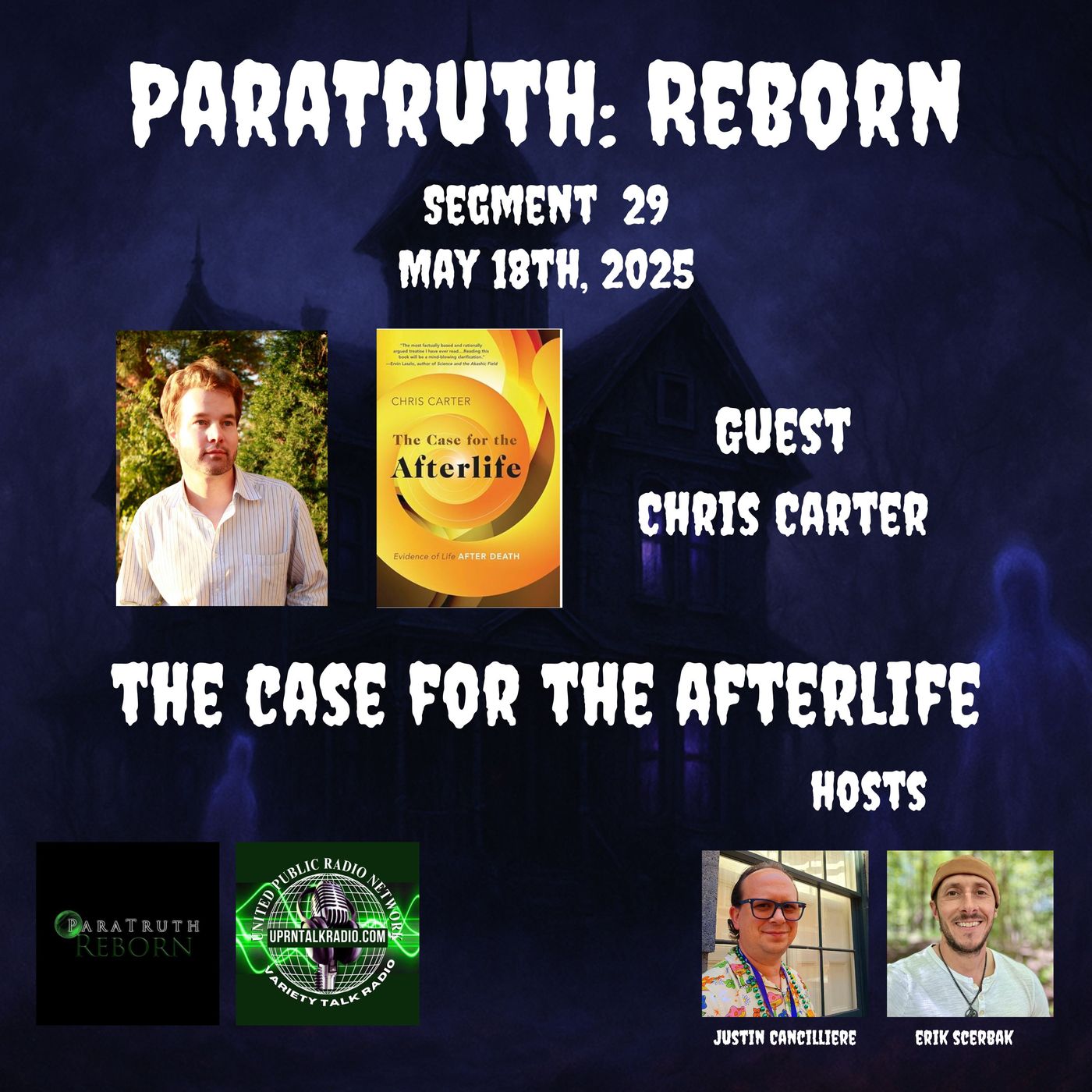
The Case For The Afterlife w/Chris Carter

 Apple Podcasts

 Spotify

 RSS Feed

 Amazon Music

 Castbox

 Deezer

 Podcast Addict

 Podchaser

 JioSaavn

 Spreaker

 YouTube
Does consciousness survive death? In this thought-provoking episode of ParaTruth: Reborn, Justin & Erik sit down with philosopher and author Chris Carter to explore the compelling arguments presented in his groundbreaking book The Case for the Afterlife. Drawing from scientific studies, near-death experiences, and philosophical inquiry, Carter challenges skeptics and offers a powerful case for life beyond the veil. Whether you're a believer, a skeptic, or somewhere in between, this conversation just might shift your perspective on what awaits us after death.
Guest Bio: Chris Carter is an Oxford-trained philosopher, and is the author of four highly acclaimed books, and several scholarly articles. His latest book is The Case for the Afterlife, which argues that the case for the afterlife can be proven beyond all reasonable doubt, entirely on the basis of evidence.
Find The Case for the Afterlife here: The Case for the Afterlife by Chris Carter
Find Chris's author page here: Chris Carter Author Page
Become a supporter of this podcast: https://www.spreaker.com/podcast/paratruth-reborn--6273542/support.
Thanks for listening!
0:03 Welcome, Well, well do para truth Truth, What's up everybody, and welcome to a brand new episode of Paratruth Reborn. This is a pre recorded show on one oh seven point seven FM, New Orleans and the United Dates. I did Public Radio Network. My name is Eric, and today Justin is running a little late, and honestly, he may not even be able to join us today. So we're gonna hold out and hope that he shows up. But if not, we're gonna have a good time anyway. So today we're speaking with Chris Carter about his book, The Case of the Afterlife. Chris Carter is an Oxford trained philosopher and is the author of four highly acclaimed books and several scholarly articles. His latest book is The Case for the Afterlife, which argues that the case for the afterlife can be proven beyond all reasonable doubt entirely on the basis of evidence. So, without further ado, I introduced to you Chris Carter. Chris, welcome to Paratruth th Reborn.
1:32 Thank you for joining us, for joining me. Yeah, thanks for having me, Eric. So the first question I pretty much ask everyone this question, but what led you to start research the afterlife, and why did you decide to write a book on it? Well, Suction my fourth book. My three books are actually a lot longer. What got me started into it? Well, I guess the unusual experience of living in a house which was purportedly haunted. This was in another country, and one night a friend of mine we're living. I was there for two years, and one night a friend of mine was where he's the fellow fellow student, and he was trying to convince me to join him and two other grad students to spend our next year living in a farmhouse owned by our college, which layout just outside of town. I wasn't really comfortable with the idea. I wanted to live closer to town in college, but he was very persistent, and he ended up telling me that the place has a ghost. His words caught me by surprise, and that basically said, is anyone seen anything? And he said no, but there's been a lot of strained sounds reported, And so I headed out to the farm to see the place for myself. It turned out to be a medieval stone house, two stories, quite large.
2:55 And. While I was there on the property, decided to speak with the college carpenter who at his workshop near the house, and after a short chat, I came straight out with it. I just asked him. I just said to him, I hear the place is haunted. He said, well, I don't know myself, but the carpenter before me he swore the place was haunted. And to make a long story short, that was enough for me, and I spent the next year living there. I did see and hear some unusual things which I could not readily explain. Nothing particularly dramatic, but these experiences did spark my interest, and so when I returned to my own country, I began to reflect on my strange experiences, and I made a visit to the local library, where I was surprised to find an enormous amount of number of books on the subject, an enormous volume of research. Specifically, most impressive was the enormous volume of research gathered by the British and American Societies of Psychical Research. These were both founded in the eighteen eighties.
4:03 The British Society was founded in eighteen eighty two by Henry Sidgwick, he was a philosopher at Cambridge, and two years later, in eighteen eighty four, the American society was founded by William James at Harvard University, and these two societies membership list read like a who's who of the intellectual elite on both sides the Atlantic of the day scientists, philosophers, historians, lawyers, scholars, and the membership included people on all ends of the spectrum. People who were diehard skeptics, people who were quite inclined to believe the data, and people who were basically neutral but open minded. To make a long story short, despite the often repeated lie that the British American societies never found anything, the truth of the matter is they found an enormous volume of research meticulous. They gathered the research meticulous first rate, and it was enough so that by the early years of the twentieth century, almost all of the members were convinced of the reality of survival, including several of those who started off as diehard skeptics.
5:15 Wow, yeah, oh, that's pretty incredible. Well, now, how did your background in philosophy and science actually influence your approach to this topic in particular? Well, the strange experiences that I had in the farmhouse didn't fit in very well with some of the materialist opinions of several philosophers that I'd struggled, that I'd studied them. Sorry with sorry, but I was open minded enough to admit the possibility that these experiences were of exactly what they seemed to be, the lingering presence of someone who had lived in the house in days long ago. I guess just affected my approach. My approach is not based upon my own experiences. My approach is basically description of various cases, an analysis, and most of all, a critical examination of the arguments of the so called skeptics.
6:25 Well, and with that said, what kind of reactions have you actually received from both the skeptics and the believers since publishing this book or any other works? Well, the skeptics are not nearly as influential or as outspoken as they used to be, say back, I don't know, twenty thirty forty years ago. They seem to have mostly receded into the background. But it's important to remember that most of these so called skeptics are actually militant atheists, and one of the fundamental pillars of the atheistic belief system is the ancient doctrine of materialism. That's the idea that all events have a physical cause or at least ultimately have a physical cause. And it follows from this that the mind is produced by the brain, and so when the brain is destroyed, the mind ceases to exist. Now, any evidence to the contrary threatens the doctrine of materialism and thus threatens the collapse of the entire atheist worldview.
7:34 And it's this, more than anything else that I explains their vehement opposition to the data that falsifies materialism. But now, in the chapter that's titled the Mind Body Relationship, speaking of the mind, what is the evidence that indicates the actual relationship between the mind and the brain and how do they work cohesively? Are they separate from each other? I think that the impudence indicates that the relationship between the brain and the mind is that the brain is a receiver transmitter for the mind, a two way receiver transmitter, sometimes from body to mind as a sense perception, other times from mind to body as in willed action. And this isn't just my opinion, this is the opinion that the philosopher William James argued very strongly for this. He was the first, as I said earlier, the first president of the American Society. It was also the opinion of Sir John Eccles. He won the Nobel Prize in physiology.
8:49 I think for discovering how neurons brain cells communicate. They do so with chemicals which crossed the synaptic gap between neurons. He killed these neurotransmitters. He believed that. So did the great Canadian brain surgeon Wilder Penfield. He won the Nobel Prize in medicine for his work with epileptic patients. And today there's other there's other philosophers and scientists who accept this. Kurt two Gas, Bob Almeter, Neil Grossman, physicist Henry Stapp, and Evan Harris Walker. So yeah, So I think the true relationship in the mind the brain is that the brain is the instrument of the mind, uh and the brain the Wilder Penfield described the brain as this as this fantastic biological computer. In other words, the mind programs the brain to handle certain automatic tasks. And we've all seen this before when learning a new skill. If you're learning how to drive a car, takes a great deal of concentration. We have to about everything. You know, put the car in gear, you know, apply the gas, look over your shoulder and all that sort of thing. But once you've been doing it for a while, then it becomes almost automatic, and we can drive the car on autopilots, so to speak. And same thing with playing a musical
10:19 instrument or learning a new sport. At the beginning requires a lot of concentration on the basics, but after we've mastered the basics, we programmed our brain to handle the more routine tasks which freeze up our mind, our minds for other things such as, I don't know, holding a conversation while we're driving, or thinking about how we want the music to sound. Do you want sound, what mood do you want to convey? Don't play it fast? Slow? How? Or playing a sport thinking about where we're going to place our next shot instead of how to make the shot. So yeah, I think the brain is the instrument of the mind.
11:03 So there's been I know, there's been arguments between skeptics and various scientists believers that the mind may or may not exist without the functioning brain. Is that something in you in your studies that you came across that the mind can indeed exist without a functioning brain. That'd be kind of like the spiritual realm of things you know, there's been discussion amongst some friends of mine that say ghosts are actually just the mind of the person that was left behind, rather than a spirit, and there's been a lot of arguments about that. What do you place that? What do you think? Well, you've mentioned a few different things. There the evidence that the brain and the mind are separate entities, and that the mind can exist apart from functioning brain. There's a great deal of evidence to this effect. And we don't even have to bring in the so called paranormal.
12:03 We don't have to bring in near death experiences, apparitions and so forth. I mentioned in my book the medical phenomenon of terminal lucidity. Now this has been known for thousands of years, and you know, the ancient classical writers wrote about it. What it refers to as this, when someone with a diseased or damaged brain is approaching death, what often happens in the final days, hours, and minutes of their life is that they suddenly become lucid and seem to regain their normal consciousness. I mentioned a case in my book about a woman who suffered from severe Alzheimer's, so much so that it damaged parts of her brain, and she'd spent approximately the last ten years essentially doing little more than staring at the space and babbling about nothing.
12:56 But one day her nurse walked into the room and found her completely lucid. She quickly phoned her daughter and explained that her mother wanted to see her. Her daughter rushed over to the hospice found her mother completely lucid, and she said it was like talking to someone who had been asleep for ten years. Shortly afterwards she died and yeah, and parts of her brain were destroyed. That's only one example. I give another example of a This is from the nineteenth century, I believe, late nineteenth century. In those days, mental hospitals were called insane asylums were lunatic asylums. And this fellow one day got a message from the director of the asylum saying this brother wanted to speak to him. Well, his brother been a little more than a vegetable for the past several years. He was intrigued. He rushed over and found his brother speaking to him perfectly, normally, perfectly lucid, and the director took him aside and saying, I've seen this before. This is a sign of impending death. I don't think your brother's gonna last very long. Sure Enough, shortly afterwards his brother, his brother died, and they did an autopsy on him, and they found that his brain was almost entirely superrated, meaning that it was almost entirely filled with puss. And
14:28 so this fellow's name was Suria. He essentially asked, how did how did this fellow with what did this fellow think? So it's well known. This is not something that's uh, that's sort of some sort of freak occurrence. It's well known among people who work with the dying and so terminal lucidity anyway, and I also mentioned it was it was This has been known for thousands of years. Hippocrates, the father of medicine, wrote about it, Galen Cicero, and others, and they all took the view that in the final moments of life, these are cases in which the mind or the spirit whatever you like, is disengaging from the restrictions of a material brain. That seems to be what happens.
15:14 And this is mainstream medicine. This, this is not necessary to bring in other forms of evidence, such as the near death experience. So do you think that this is the case in terms of like individuals who might be close to dying who say they're seeing shadows or seeing angels appear all of a sudden Is that because their mind is now drifting into away from the materialistic aspect of the world and it's moving into the spiritual or I know sciences have some sort of chemical reaction that causes those beliefs or those visions. Okay, well, now you're moving into the so called paranormal evidence.
15:54 The evidence is extreme outside of mainstream science. In my book, I discussed five different lines of evidence deathbed visions, the near death experience, apparitions, children who claim to remember a previous life, and communication parent communication from the deceased via human mediums. These five lines of evidence are all very different from each other, yet they all point in the same direction that essentially, the mind can operate in the absence of a properly functioning brain, and after this life we can expect a lot more.
16:40 Okay, well, now it's going on with the paranormal a little bit here, Like regarding near death experiences in particular, how does the near death experience actually support the argument for life after death? Like, is there any actual evidence there that you've come across. The near death experience certainly suggests that we survive the deaths of our bodies, because these are cases of in which people who MH have no heartbeat, they're not breathing, they have no blood supply to their brain. When they're revived resuscitated, they describe hovering above their bodies. They describe feelings of peace and joy. They sometimes describe moving through a tunnel afterwards, meeting departed friends and relatives.
17:42 Or. Mysterious beings who they can't which they can't identify. It certainly suggests that we survive death because the nd I mean, because they report, first of all, didn't case. The mind can operate distinctly from functioning brain. The mind can operate and have complete, even more clear than normal lucidity at times when there's every medical reason to believe that the brain is either well the brain is simply not functioning. And also they, as I said, they report contact with departed friends and relatives.
18:25 So well, I'm moving back, and forgive me, I'm gonna be jumping back and forth the paranormal and the scientific aspect of all this stuff. But what role does quantum physics or interpretations of it play into the argument for the afterlife indirectly. Indirectly only I mentioned physicist Berkeley physicist Henry Stapp, that's another physicist, even Evan Harris Walker. Both of these fell have taken the ideas of people such as Sir John Eicals and basically run with it. Staff for instance, argues that the mind interacts with the brain at the level of the synaptic gap because you've got chemicals Adam's molecules being transferred in between in between over the synaptic gap from one year on to another. And he argues that because these are events at the atomic level, quantum effects become relevant. So I mean, I've got an appendix on quantum mechanics. The contribution of modern physics is indirect, but it is there. But also the reason why I bring it in is because some philosophers such as Daniel Dennett,
19:56 will argue that dualism has to be ruled out on the basis that it would contradict physics. Well, this is complete nonsense, and so I go to some lengths to show that this is nonsense and it's not even necessary to bring in quantum mechanics. Because there was a philosopher and a physicist. He was both named CD Broad and the early years of the twentieth century. He argued that you can't rule out dualism on the basis of physics. Just because all physical to physical interactions require an exchange of energy doesn't mean that physical to mental or mental to physical interactions require an exchange of energy. There's no logical reason to assume that's true. So even on the basis of classical physics, you know, pre quantum physics, you can't rule out dualism on the basis of the science of physics.
20:53 Right, do you think that you know, when it comes to physics or just science in general, which often seems to want to disprove this idea of life after death, do you think that sometimes they will interpret the evidence purposely in their favor or do you think that what they're finding actually just happens to be in the favor of you know, life and death, not life after death, not existing m. You've raised a few different issues there again. First of all, First of all, I don't think that that's mainstream science is in the business of disproving the afterlife. There are scientists who are very scientists tend to be open minded.
21:35 They don't tend to be a closed minded bunch. The so called materialists, materialist skeptics, militant atheists, whatever you want to call them, they're definitely in a small minority. I mean several certain I'm aware of two different surveys that are vast scientists for their opinion on the existence. So, for instance, extrasensory perception, and the vast majority of physical scientists came back and we're either open to either said, agreed with extra sensory perception being either an established fact or real possibility. Most of the negative responses actually came from psychologists, And if you ask these psychologists why they don't believe in extra sensory perception, they'll usually say something along the lines of, well, we turn the laws of physics upside down. So the psychologists are saying that, but the physicists know better, they know that that simply isn't true.
22:32 I don't think we have evidence that the mind and the brain are distinct and the mind can exist in the absence of a brain. I don't think there's any evidence disproving that all the arguments that are commonly used, for instance, that you know, I don't know, injury to the brain can impair thinking or Alzheimer's it can impair the mind. Of course that's true. But those things are true whether or not the brain produces consciousness or whether or not it's receiver transmitter. I mean, I like the analogy of smashing a radio receiver. The mistake they're making can be Australia with the analogy of smashing the receiver radio and you know, causing the music to stop and then concluding that the radio was producing the music. Well, the radio does not produce the music. The radio transmits the music. I mean, just because you damage some of its components doesn't mean you damage the music. It means you damage the transmission. So brain damage, Alzheimer's in the like certainly do not prove or not evidence that the brain produces the mind. And again I mentioned terminal lucidity that certainly is evidence to the contrary that the brain operates as a receiver two way receiver transmitter for the mind.
24:01 And when we're thinking of like the mind existing without the brain, or even just say spirits walking the planes or you know, being able to contact these entities in particular, there is a grand number of people that claim they can do it. However, there is quite a few skeptics that say the evidence of for example, mediumship in this case cannot actually be trusted, and that it could be the work of some sort of satanic spirits or even a fraud aught together, especially since there's been so many proven frauds over the years. That we have people on two sides of the table saying mediumship is very much real and these people can indeed speak with the dead, and the other side saying there's no way, it's impossible.
24:52 What do you found regarding that? Well, again, you've raised a number of issues. You've raised, you've raised fraud, you've raised you've raised other other objections as well. What don't we do with one issue at time? Okay, let's deal with fraud. The British and American societies began investigating both physical mediums and mental mediums. Now, physical mediums they're the ones that uh, you know, uh, purport to produce physical phenomena, you know, levitating tables or musical instruments that play themselves, or even you know, the physical appearance or the deceased person and things like that. Mental mediums are different. Mental mediums either relay messages verbally or by going into a trance and writing on a piece of paper.
25:41 They soon abandoned their study of mental medi of physical mediums after they exposed several fraudulent physical mediums. So, and also physical mediumship is just too easy to dismiss on the grounds that you know, mistake and I would testimony or mal observation or fraud. And so they they abandoned that and they concentrate their efforts on mental mediums. Now, most of the mental mediums that they studied were not professional mediums. These were women of women of high social almost entirely women of high social standing. One Missus Verel, she was a lecturer at Cambridge, Another one Miss Coombe Tenant, she was Justice of the Peace and Britain's first female representative to the League of Nations, which was the forerunner of the United Nations. I can only think of one professional medium that they studied. That was a Missus Piper of Boston. And what they did was they were very impressed with her, and they put her on the spr Society Cycical Research payroll so that she didn't have to do her mediumship for a living and they could she could devote her time to working with the researchers. So fraud is essentially ruled out because if these are these are non professional mediums. They weren't paid for their services, with the exception of Missus Piper, and in many cases
27:13 they wrote under pseudonyms because they didn't when they were alive. They didn't want their names being associated with this. These are These are women of who had careers as lecturers or as as representatives to the League of Nations or what have you. Their husband, they were the wives of politicians and so forth, so they kept their mediumship a closely guarded secret. So I think given their high social standing, given the fact that they were not professionals, I think that rules out. And given the fact that the researchers were not idiots and they did were not interested in physical mediumship, that rules fraud out conclusively.
27:59 Take another turn here, what are your thoughts of beliefs on reincarnation? I'm sorry, what am I? Your thoughts are beliefs on reincarnation? Oh? Okay, Well, as I said, As I said in my book, I consider five independent lines of evidence. Children who claim to remember previous lives is one of the lines I consider the most extensive and probably the most thorough work on that subject was done by a psychiatrist named Ian Stevenson. He applied for a grant to go to India and study this issue back in the nineteen sixties. He took ads out in two different Indian newspapers asking for people with who knew of children who claimed to remember a previous life, and he investigated several of these cases. But he was only interested in active, ongoing cases. In other words, he wasn't interested in cases you know my you know, I remember my brother twenty years ago when he was a kid. He wanted in which the children were still talking about it, but they were young enough to still talk about it, and the case had not been properly investigated.
29:10 So you found several of these cases, which you put together in a book, a famous landmark book. And he followed that up with more studies. He originally concentrated in India, but then he widened his scope and found cases in Western countries as well. Reincarnation is an ancient belief. I mean it's found all over the world, not just in places like that we associate with reincarnation, like India or China or what have you. But among Australian Aborigines, several Native North American tribes, the Inuit of the Arctic, some African tribes, the Vikings of Scandinavia, and I present evidence in my book that this was also found in the pagan world. There's evidence that many of the early Christians believed in reincarnation until the Second Council of Constantinople, which was not called by the pope by the way, it was called by the Emperor, one of the Roman emperors.
30:21 And so some have argued that I shouldn't be considered binding. Even today. There was a Pew Center research study Pew spelled capital p capital ee, capital W. They surveyed American Christians and they found that approximately twenty nine percent of them expressed a belief in reincarnation. I also argue in my book that there's nothing in the New Testament that rules out of belief in reincarnation. Again, many of the early Christians accepted it, and Pagans, and I think that the reason why people are sort of repulsed by the idea of reincarnation because they don't want to be trapped on endless, endless wheel of birth and death and rebirth and life and death and rebirth. But I also present evidence that such fears are groundless. There's reason to believe that most of us only incarnate two or three times.
31:25 And anyway, I just like to read something very briefly here by let's see here. Okay, Yeah, several modern theologians are arguing that, you know, we should take reincarnation service. The Christians should take reincarnation seriously. Let's see here. So there's theologian Gettis McGregor. He writes, reincarnation takes care of the problem of moral injustice. To that age old question of job, why do the wicked prosper and the righteous suffer? The reincarnation has a ready answer. We are seeing in this life only a fragment of a long story. Death is but the end of a chapter. It is not the end of a store of the story. And then there's Leslie Weatherhead, former president of the British Methodist Conference.
32:14 He asked in his case for reincarnation lecture. These are his words. If I fail to pass those examinations in life, which can only be taken while I dwell in a physical body, sure I'll not have to come back and take them again. But I mean, you know, I mean, once we've learned the lessons of physical life, there's simply no reason to repeat them. All right, we'll going off and mentioned at least for a while, Christians were strongly believed in reincarnation. But when you consider the Christian doctrine that you know, once you were saved by Jesus, you are cleansed and clear of all your sin. There is no need to do any work to grow you know, strong, more righteous. Therefore reincarnation shouldn't be necessary. What is your argument for that? Like, how do you, I guess, how do you oppose that belief?
33:11 Because I mean that's like, you know, if Jesus washes away the sin and there's no sin to worry about, then what need is there for reincarnadish shin recarnition. Well, I don't think that just because somebody becomes a Christian that means that they have necessarily learned all the lessons of birth life that there aren't learned. For example, a common Stevenson looked for patterns in the former lives of these children who claim to remember a previous life, and what he found was a high incident of violent death, a high incident of dying young. So there seems to be a sense of unfinished business among these children who claim to remember a previous life. So I guess to answer your question, just because a person is a good person, or a person has come to an acceptance of the teachings of Jesus Nazareth, I don't think that necessarily means they've learned all the lessons of earth like that they're here to learn.
34:25 Yeah, sorry, do you add anything else? I was just gonna say that there's I mean, all of us have room. To grow, for sure. For sure, So is there a reason why children I mean, I know you had said that children were studied in primarily because they were young enough to still talking about the life prior that, for they were remembered it. But modern times, like nowadays, I have even a couple of friends who have gone into therapy sessions and they've been doing shadow work to learn why they have certain fears, and they're starting to, I guess, pull memories from past lives themselves. Now, are there enough studies on adults to like prove that they too have had a past life or those like I guess I'm those as as accurate or as real to use his evidence?
35:20 Or could that be something else entirely for these people. Well, I'm not familiar with that, okay, with that, those stories, so I can't those cases, so I can't. I don't feel comfortable commenting on them. Most of the cases that Ian Stephen even Stein's even Ian Stevenson studied involved children. These are children who normally begin to talk about being somebody else in the previous life as soon as they can begin to speak, but once they reach about nine ten years old, the memories fade. Once they're eleven or twelve, the memories are usually almost completely gone. So it's the case is that Stevenson dealt with or were children who remember a previous life, not adults remember a previous life.
36:12 That doesn't mean they didn't have one, of course, or that this is the first time they're here. That just means the best cases involved children. I will say that what I find interesting is you said, how with these children it seemed like in a previous life they had died relatively young. And therefore, and I've noticed from the case studies that I've read on adults who are going through this psychotherapy and learning about their past lives, that they too have either gone through some sort of highly traumatic entry or even a very early death, either by you know, being shot or in the wild West, or you know, being killed by sword. So again, I mean, I just find that really interesting that it does still line up with some of the stories of these children.
36:57 Then, Okay, all I can really say is I don't know much about any evidence involving adults, and so I tend to be skeptical about such evidence in the real sense of the word, not in the phony sense. Skeptical in the sense that I'm practicing. I'm suspending belief. I'm not refusing to believe. Okay, So, what are the most common misconceptions that people have about the afterlife evidence and how do you usually address them? Well, I'll already mentioned one. That's the the often repeated lie that the British and American societies investigated and found nothing.
37:46 They found any harvest volume of research. There's a library in England, there's a library in Boston. I think I think that the ASPR library is still open. I'm not sure. Don't quote me on that. But they found an enormous volume the research, and they gathered it into journals, the British Americans, the BSPR Journal, the Journal of the American Society of Psychical Research. So that's one misconception, and I think that that miss that's sort of like saying, you know, well, don't bother to look at the evidence, because there's nothing there. There's an awful lot there. As I said earlier, that's one misconception. Another misconception is there is no evidence, it's all a matter of faith. No, it's not a question.
38:28 It's not a question of faith, it's a question of evidence. And on that topic, I just want to read something else. The British, British and American Societies. The membership also included a clergymen, and one of them was the Reverend Charles Drayton Thomas. He was a Methodist minister, an active member of the British Society of Psychical Research, and he participated in many sittings with renowned mediums and uh he wrote once these are his words. Perhaps it will be asked what benefit may be expected from the general acceptance of this evidence for survival. I think it will do for others what it has done for me. It has supplemented and reinforced my faith, both in times of bereavement and in the prospects of old age and death. Also it has further emphasized the value of personal religion. So there's no there is no conflict between Christian belief and the evidence they supplement and reinforce each other.
39:37 And forgive me if you said this at the beginning of the show, but do we know why the British Americans like lied about the evidence that they found? What the membership of the British and American societies never lied about the evidence they found. It's the. Materialists, the so called skeptics, who have often remarked all of those societies found nothing, society awful lot. Yeah, I apologie. I thought you were saying that they had lied about it, about all the books and stuff that they found found. No, no, no, they wrote the books, thereonicals, they wrote the studies, they built the libraries, they conducted the research.
40:24 Well, now, how do materialistic world views limit our understanding of consciousness and survival? Well, I guess they give us this enormous blind spot. I don't think we should go through life wearing blinkers, just ignoring uh evidence that doesn't fit in with our preconceived ideas. I know that's certainly the easier path. It's always difficult to change our minds change our opinions. Most of us regard our opinions as uh valued personal possessions, and so we try to the normal human instinct is to try to hold onto them and defend them against any sort of challenge. But uh, there's nothing here to be afraid of.
41:15 Well, now, if consciousness uh does survive death, but what does that mean? Do you think? What does that mean for how we live our lives now are going forward? It's like everybody just believed that. What do you think we should be doing? Well? One of my appendices, I've got six appendencies in the book, and one of the pendency appendices is why do why does what we believe matter? Yes, it's Appendix three. I'm looking at it right here. Is that essentially what you're asking me? Why does what we believe matter? Yeah? Yeah, if consciousness exists after death? Yeah, well it because what we believe determines to a large extent, how we how we live our lives here and now, I mean I mentioned the philosopher and this appendix three, who mentions this? And you know, I mean obviously such a belief can overcome the fear of death and extermination. So if nothing else, it can help us put that fear aside and allow us to get on with living our lives without that fear lingering in the background.
42:28 He mentions five other benefits. But again and again, the communications coming through mediums stress the importance of realizing that this life is not all there is. And that well, I think there's someone named Julia who communicated through a fellow name a journalist named W two Steed. Steed went down with the Titanic, but before he did, in the years before that, he actually discovered he was a gifted medium, and he put together this book titled Letters from Julia, which are a series of communications from a woman, a young woman who died that he knew. And one of the letters is like this, where Julia stresses great importance of knowing more about the true reality. And this is what this is part of the message it came through.
43:18 You may think it's strange that the verification of another life should increase the importance of this, but such is the fact. And you can never understand the importance of your life until you see it from this side. You are never, for one moment idle from influencing eternity. Wow, do you think that belief in the afterlife has ethical or societal consequences. I personally, I think. So, I mean, think about again, what we believe determines to how we live Our lives depends to a large extent on what we believe comes after it and what we believe to be the nature of the universe. So think about what we're doing to the what we're doing to the environment right now, I mean, we're damaging our We're run the risk of irreparably damaging our ecosystem, putting our entire civilization in grave danger. The problem, of course, if we reach what's called kipping points, points of no return, essentially simple. One of the simplest examples I can think of is with regards to melting of the Arctic ice caps. Now, the snow snow caps, the snow and ice of the Arctic being mostly white. It reflects the sunlight coming in. But because of global heating,
44:54 they are beginning to melt. And that's and that's doing two things. One thing it's doing is it's releasing It's exposing the soil underneath in which methane is trapped. And the methane is also heating up and being released into the atmosphere. Methane is even more potent gacid global heating than carbon dioxide. And so the more methane is released, the more the earth heats, the more the polar ice caps melt, the less sunlight is reflected from the polar ice caps back into the space, the more methane is released, and so on and so on in a vicious circle. That's one example. If we reach the point where that process becomes almost irreversible, that's a tipping point, a point of no return. It self reinforces itself. More heating caused, more polar ice to cap, more methane released, less sunlight released back in space, higher temperatures, more melting of the polar ice caps, more methane released, less sunlight reflected back in space, and so on and so forth. So these these are the sort of sort of things that keep climate scientists up at night. Many of them. You talk to them and you feel a sense of desperation in their voices, or sense of almost panic. We can't cross these tipping points, because if we do, then all bets
46:24 are off. Now. All these people are saying, mostly people who are lobbyists with the oil and coal industries. You know, they're saying that you know, global global, they're trying to raise doubt. There's I called from merchants of doubt. They're not trying to prove that global heating is not man made. They're saying, you know, the science is inconclusive. It hasn't been settled. There's no consensus. You know, there's arguments on both sides. There are no good arguments on the other side. Uh, the planet is heating up, and all the evidence suggests that we're doing it with our emissions. But why would some why would these people be doing it? Well, obviously because they benefit financially from the production of fossil fuels, either directly because they work with these companies or their shareholders in these companies, or they own these companies, or they're being paid to lobby for these companies. But if you believe that death is not the final word, then this life is not all there is, and it changes our definition or our idea of what it means to play the long game. In other words, the game doesn't end with our deaths, and so we should be concerned about this fate of the planet and future generations and not simply just live for our own lives, right or live for ourselves.
47:47 I totally agree with you. You know, while you're talking is making me think of like during COVID when everybody, you know, the whole world is pretty much shut down, and how many of the waters in Venice started to clear up and dotin started coming in. They haven't you know, been spaying those waters for years and years and years, and we've seen pollution at that time kind of subside and the ozone started to shrink a little bit. And it amazes me how often, you know, people will talk about global warming or certain animals going extinct, or the mountain, pollution within the Indian Ocean, or just in the oceans in general for that matter, and yet they don't seem to care. Like I watch people. I live in Cleveland, Ohio, and I watch people driving down the street. They'll take a bag of McDonald's just toss it out the window.
48:38 It's all their garbage is hitting the ground and they keep on going and I see it over and over and over again, and you know, it's it's it. Really, I think it's sad because these individuals are you know, they think, oh, well, even if it is real, if global warming is happening, if these animals are going extinct if the world is as polluted as it is. The tipping point isn't going to happened in my lifetime, So you know who cares? And you know that just goes right along with what you're saying that we need to focus on future generations and what the earth is going to be, you know, ten years, twenty years, one hundred years from now, and savage, there's so much selfishness I think in some of these people that live in this world that they just you know, they're they're ignorant to it, or they just simply don't care. Yeah.
49:27 Well, the great novelist George Orwell he uh, I think he expressed it quite well. He said, what was it now? The greatest the greatest threat to mankind is the decay in the belief in personal immortality. I think that, Yeah, I think that a lot of these people who are Milton atheists or hostile to the idea of religion, hostile to the idea of an afterlife. These are people who don't want to be held accountable for their lives. M It's it's just wild. It's boggling to me, you know.
50:14 So we're kind of getting close to the end here. So I've got just two more questions for you. But uh, first and foremost, what if anything, would you want your readers to take away from this book in particular? Mhm m all right, I guess uh that. See, this is my fourth book, and all four of my books are attacks on the skeptical fortress. If the first three can be thought of as an ar model, then this one is more like a surgical strike. It's much more, much more focused, much more. Yeah, it's it's it's basically a lot more focused. It's shorter.
50:55 I think it's. Important to realize that if a person is familiar with the best evidence for survival and has the tools that I give people in the Toolkit, because my first part of the case for the Afterlife it's called the toolkit, and I give readers the tools necessary to evaluate the evidence and the skeptical objections, then the supreme irony of studying the skeptical objections is that it results in an even greater conviction that we survived the deaths of our bodies because we realize that the counter arguments are all very very flimsy. Don't stand up, do not stand up to critical scrutiny.
51:46 Right. Well, my final question is I just want to give you the opportunity to share, you know, where people can find you, where they can find your book, anything that you'd like to share. The floor is all yours, okay. Well. The book is titled The Case for the Afterlife. It's available on Amazon dot com, Amazon dot CA, a Amazon dot UK, and various other outlets too, good Reads a few others. It's also available at fine brick and mortar bookstores where I like to shop, such as Barnes and Noble. It's not hard to find, oh. They can also they can also go to the Llewellyn website, my publisher's website, and maybe later on Eric you can provide a link a link for absolutely on a beliek for it, and they go to the Lawell and Read website. They can read a description of my book. They can read endorsements of my book from fairly well known individuals in the field.
52:44 And they can also read a short essay that I wrote I think the I think it's called uh, can we prove that we that we survived the death of our bodies? Or something like that. It's basically it's basically a short essay which will give readers a good idea of how of how I write and what my book is all about. All right, well, Chris, thank you so much for joining me. It's been a real pleasure talking to you and getting your thoughts on all of this. It's been awesome. Yes, thank you, Eric. All Right, folks, So that was Chris Carter on his book The Case of the Afterlife. Make sure you check out this book if you If you don't have it already, you should definitely go to the Wild dot Com or any of the other sides. We're gonna have links down here in the descriptions for you. Make sure you click on those and check it out. It's a pleasant read, it's fascinating and if it doesn't just blow your mind some of the evidence that is in there. I don't know what to tell you, but definitely check it out, y'all.
53:41 So with that said, unfortunately, obviously you guys saw Justin did not join us today. He was busy with some work related stuff. So he will be joining us again next week, of course, So just make sure you like, share, subscribe wherever you listen to the show. Also make sure to check out the other shows I needed Public Radio Network where We just want to build a community of listeners and show hosts here. So again, this has been a pre recorded show on one of seven point seven FM New Orleans and United Public Radio Network. So until next week where you will find us at the same time on the same channel. My name is Eric Peace.


