When Darkness Becomes Your Teacher w/Kelly Ann Street
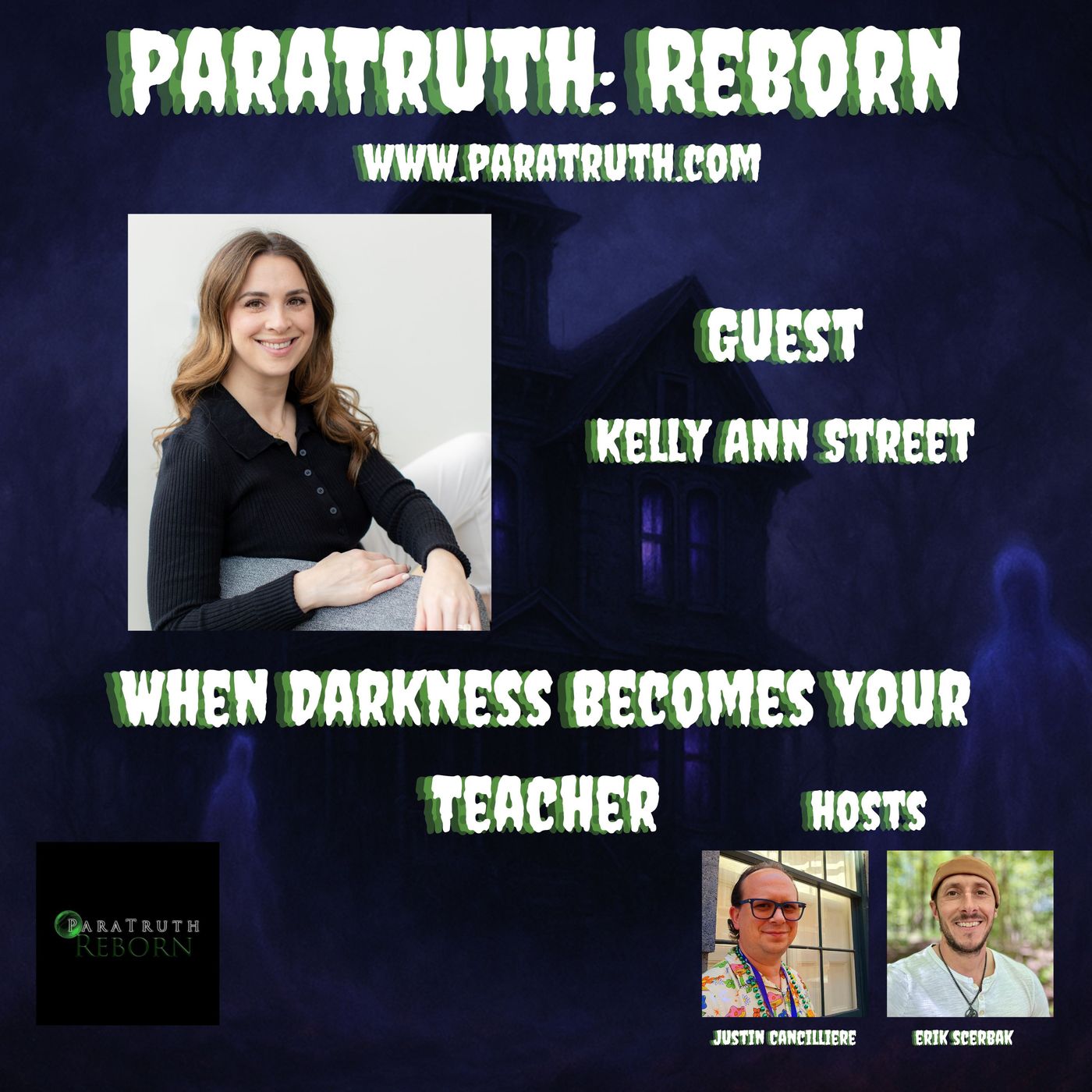
What if your darkest moments weren’t breaking you… but shaping you? In this episode of ParaTruth: Reborn, we sit down with Kelly Ann Street, licensed therapist and author of Embrace the Dark, to explore shadow work, healing, and the power hidden...

 Apple Podcasts

 Spotify

 RSS Feed

 Amazon Music

 Castbox

 Deezer

 Podcast Addict

 Podchaser

 JioSaavn

 Spreaker

 YouTube
What if your darkest moments weren’t breaking you… but shaping you?
In this episode of ParaTruth: Reborn, we sit down with Kelly Ann Street, licensed therapist and author of Embrace the Dark, to explore shadow work, healing, and the power hidden within life’s toughest moments.
🔮 Topics include:
- Shadow work and emotional healing
- Dark nights of the soul
- Reconnecting with your true self
- Practical tools for growth
👉 Don’t forget to LIKE, COMMENT, and SUBSCRIBE for more conversations exploring the unknown.
Guest Bio: Kelly Ann Street is a licensed therapist, author, and speaker whose work focuses on trauma, grief, and major life transitions. She integrates depth psychology, Internal Family Systems (parts work), psychedelic-informed perspectives, and intuitive practices to help people navigate dark nights of the soul and reconnect to their body, minds, and spirits with clarity and self-trust. She is the author of Embrace the Dark and host of the Embrace the Dark & the Light podcast. You can find her on Facebook and YouTube @kellyannstreet and on Instagram @embracethedarkandthelight.
Become a supporter of this podcast: https://www.spreaker.com/podcast/paratruth-reborn--6273542/support.
Thanks for listening!
0:00 Coming up on Paratruth re Born, I'll be talking to Kelly Ann Street about her book Embrace the Dark. Welcome well, do Parah Truth True. Welcome Paratruthers to another episode of Paratruth Reborn. My name is Justin and I'm very excited today to welcome Kelly Ann Street to the show. Kelly, Welcome to Paratruth be Born.
0:53 Hi, thank you so much for having me. Absolutely. So, I've been doing this a lot where I'm getting people on to talk about your shadow self, and I'm starting to really wonder if my shadow self is trying to get me to bay attentionon. So, before we get into the book, what made you want to start on this work work and write the book. Yeah, it's sort of one of those things where was it something that chose me or did I choose it? Or was it something that chose me? Almost like I think you doing all of these shows on shadow work, is that's something that's really showing up for you and kind of hitting you in the face with itself. And so I think I think that's that's really why I came to the book, is I was I was doing my own shadow work. I was seeing it in my clients.
1:48 I was in this space where I finally had the a little bit of a little bit of space, I will say again, to go into shadow and to really spend some time with all of the things that I maybe hadn't dealt with or hadn't dealt deeply enough with, and it was time for me to process them for myself. And in doing that, I realized that I had all of these tools that I wanted to use for myself but then also share with other people to go into their shadow. Okay, now the name of the book is Embrace the Dark. What does that truly mean? To embrace the dark?
2:32 Yeah, so I think embrace the dark to me means that it's something to be less afraid of. I like the idea of embrace as accept as to bring in, as to welcome in, and to me, I think part of the thing that I want to get a message that I want to get out to people is that the dark is not necessarily scary, it's not necessarily evil, it's not necessarily bad. And so if we can welcome in by embracing what we think of as the dark as the shadow, then maybe we can soften into it.
3:15 Maybe we can be a little bit more present with ourselves and the things that have been uncomfortable or hard or difficult in our lives. Okay, Now, a lot of people hear shadow and they think, you know, evil, they think bad. Why do so many people fear their own shadow? Is it just because we're kind of predisposed to hear shadow or darkness and think not good? Yeah? I think so. I think there's a lot of history around whether it's you know, religious trauma and in that sort of thing, but there's a lot of history around the dark or shadow being bad, being scary, being evil, and those messages continue today. That's, you know, that's why we're here. And yet I think part of what it is in our modern world why the shadow still feels so scary is that it's the unknown. It's it is the shadow. It is the dark for a reason because it's not something we're either yet aware of, or it's not something that we have fully processed and brought to light and come to terms with. Or Another reason why we often think of the shadow as evil is or bad or scary is that our shadow is stuff that we've been rejected for or been told is unacceptable about ourselves.
4:44 In the past, and when you've been rejected or hurt because of a part of your personality and then you need to face that or want to integrate that back into yourself. That's a really frightening part prospect. Now, we asked, we did a poll and asked our paratruthers have you ever experienced a dark knight of the soul? And one hundred percent of them said not sure what that is? So what is the dark knight of the soul? Yeah? So is it? Okay? If I give like a little bit of a history lesson here U? Yeah, fabulous, Okay, So I feel like you can't explain what a dark knight of the soul is without knowing its origin. So in the fifteen hundreds, there was a Carmelite monk named Saint John of the Cross, and Saint John of the Cross, like many you know, monks and religious figures during that time, was persecuted for his very particular brand of Christianity. His type of Christianity was some for some reason outlawed, not allowed during during that time, and he was put in prison.
5:56 And so while Saint John of the Cross was in prison, I think he was an maybe necessarily Saint John of the Cross then, but he was put in prison. And while he was in this prison cell with you know, stone walls, cold, no food, you know, very little food, very little water, all he had was his mind. And while he was in that prison cell, he was thinking, you know, why is my God not here saving me? Like I'm I'm in prison for my beliefs and I'm not I'm alone. I don't feel a connection to God. And he started writing this poem that later became known as the Dark Knight of the Soul. And so he writes this poem, but he doesn't have pen, he doesn't have paper, he doesn't have anything to actually write it down on. So he just repeats the poem over and over and over in his head. And then when he does get out of prison, eventually he writes the poem down and he wrote a whole book explaining what the poem was about. And really the heart of the poem and his experience and a dark Knight of the Soul is a sense of complete and utter abandonment of your your soul being lost being you know, you don't have any anything to hold on to, there's nothing tangible to feel.
7:17 And I think when we've when we've gone through an experience in our lives where you're just you know, you're going about your day. You have a connection to something greater than yourself or some meaning in your life. It doesn't even have to be religious or or religion. I'm not particularly religious myself, but when you have a connection to something other than yourself, something greater, or even a connection in with yourself, and then that goes away, you you lose your meaning through losing your faith in something, losing a relationship, losing a job or a career, and all of a sudden, what you these walls that you have built around yourself of meaning of who you are go away. That is a dark knight of the soul.
8:03 Okay, well, I'm glad you kind of gave that history because I literally had to look this up before we got on today because I had never heard of it either, So it didn't surprise me that our listeners didn't either. But yeah, that's fascinating, especially like he was able to not just become in touch with his spiritual self, but got down into his own psyche because he was just alone. Yeah, yeah, absolutely, you know, a dark height of the soul really brings you to your knees and has you question everything you think about yourself, everything you might think about the world. And from that place that to me like that is embraced the dark. That you get to that place you're on your knees, you don't know where to turn or what to do, and from that place is where you rebuild and where you reconnect and get to know yourself and love yourself, hopefully a little bit more deeply.
9:08 I feel I've had a lot of those, So I think maybe it's time to do some chef work and rebuild myself. Yeah. Now, how can pain actually become a tool for healings of something to escape or even just not letting go of it? Yeah, it's I think. You know, it's interesting you say pain, and I know we're probably you're probably meaning emotional pain, and that is definitely, you know, one one aspect, one version of it. But I will say immediately I went this idea of physical pain, and so I want to speak to that a little bit because a lot of my work with people and with myself is in the body and in somatics, and so whether it is physical pain or emotional pain, that pain is a clue that pain tells you something is not right here, something is off, something is happening that we need to address. And so you know, if it's I'll just say, if it's physical pain, and whether you know you're you're having consistent lower back issues or you know your shoulder has really been bothering you, and you know it's maybe not just from you know, playing too much pickleball or whatever it is, and you can tune into and just maybe close your eyes and go in to that part of your body wherever you're
10:39 feeling that physical pain and just ask yourself or ask the pain, what do you need me to know right now? And you can do that with your physical body, but you can also do that with your emotions. And so when you're feeling grief or sadness or jealousy. Jealousy is a big one that I really like to work with with people, as well as anger. And when you're feeling those emotional pain points, you can use that as a queue to turn back into yourself and just quietly ask the question, what do you need me to know right now.
11:21 Now? A lot of people, like I said, they hear shadow, they get worried, but what is like the biggest misconception people have about shadow work when you're when you're talking to. Them, Yeah, I think maybe that you also have to get really like dark, or that you have to be in a really bad place maybe to work with your shadow. I think sometimes it's when I'm in a in a you know, good or a more balanced place, that I'm actually able to access more shadow because I have a deeper level of self compassion and trust within myself, rather than necessarily if I'm if I'm not in a place of grief or of loss, and yet I have some uncomfortable feelings that are coming up. For instance, I love to gay examples. And for instance, today actually with one of my clients, what came up was really talking about comparing themselves to other people in their industry on social media.
12:31 And so this client is an esthetician. I happen to know, she's like an incredible, incredible esthetician who you know, works with people's skin and is really skilled at her work. And yet she's seeing that other people are posting about stuff they do online and they're talking about their career and they're getting a lot of ego boost and platitudes for it. And so she's you know, looking at all this social media and she's just feeling crap about herself. And from that place where she's looking at others, she's seeing all of this comparison. Maybe she's not, you know, in the darkest spot. Maybe she's not you know, she's not feeling this complete sense of loss or abandonment. She's just kind of not feeling great about herself. From that place is where you can bring in samples of shadow work, where you can start to dig in a little bit and just kind of dip your toe in, so to speak.
13:33 Okay, something that I think is really fascinating in the book, as you talk about seven areas of life, can you talk about what the seven areas of life are and what the what hits hardest for most people. Yeah. So the Seven Areas of Life is based on the concept of a wheel of life, and that was a development tool developed in around the seventies by a guy named Paul Meyer. And he created the Wheel of Life as this way to create a visual wheel, a visual concept of the areas of your life that feel imbalance and feel out of balance. And so when I was working with the idea of writing a book about the shadow and how to help people heal through it.
14:25 I would. I turned to this tool that I've used with my clients, I've used with companies that I've worked with, I've used in my own personal development, and I gave it a little twist by creating it as an acronym, which I just I love to make things that are easy and simple tools for people to remember. So my wheel of life is embrace. It is oh my gosh, you know what. I'm gonna be honest with your listeners here. This is a This is a real moment of life honesty and transparency. I will admit as a I have a four month old postpartum that my brain just does not work as well as it used to, and my memory and recall are not amazing. So a moment of honesty, transparency, and some embarrassment showing up. But I'm going to turn to my book and read vacronym. So my areas of life are embodiment and so that is of course our physical body, and then meaning the way you connect with something bigger than yourself, becoming, which is really personal development and growth relationships and this is romantic friendship and familial abundance, our relationship with money, calling the thing that we choose to do in our life that gives us purpose. So I would say for you, it's probably this podcast and
15:57 this work you do with people, environment and the places that we live. So we all experience relationships, we all experience some sense of purpose or a job in our lives. We all have a place or places we've lived, and so on and so forth. We all have bodies, and we can experience a dark knight of the soul in any one of those areas. And I think they the reason why I picked up the areas of life is that each of those areas, when we experience a dark knight of the soul in them, it looks a little bit different. It feels a little bit different. A dark knight of the soul, and the body is related to maybe pain or illness, or a difficult relationship with ourselves and what we look like or what we've been told we should look like, and that that's a very different feeling than a dark knight of the soul in relationships where maybe you either lose a life or you can't figure out how to have friends.
17:05 Okay, something that you mentioned earlier is talking about people suppressing parts of their personality because somebody didn't like that part of them, that person so and I'm guilty of it too. I suppress a lot of my personality because I don't feel if I was my true self people would accept me. How do people reconnect with those parts of themselves that they've suppressed over the years. Yeah, my favorite. One of my favorite ways to do that and to work with people in reconnecting with those aspects of themselves and their personality that were suppressed or are suppressed, is to look at old photo albums, To look at pictures of yourself as a child and through all different ages, especially if there's an age that you can remember being particularly difficult. Pretty much everybody had a difficult middle school and you know, preteen years and early teen years, and so definitely look at if you can access either internally your images or better yet, if you do have photos. But really, any age where there's something where you just remember a sense of sadness or of feeling kind of rejected, go back, remember who that child was, and maybe what was it that felt like it was rejected or not acceptable, and think about was it was
18:36 it really that bad? Was it really that wrong? And maybe then you can start to bring in a little bit of compassion or care or acceptance of that little you that wasn't fully accepted for who they were. And you know, justin I just want to say, I keep looking at your shirt, and obviously when people are listening, they're not going to be able to see the shirt that you have on, but I just have to say, like, your your shirt that you're wearing is bold, bright colors, has these beautiful mushrooms on it. And I'm a huge fan of mushrooms, I will say, in all varieties and ways, and enough set on that. And so seeing your shirt, I'm just I'm seeing this this joy, this playfulness, this childishness, and it's it's a really lovely image to have. And I just I just wanted to note that, and how I wonder how that shows up for you.
19:37 I appreciate that. I mean, this is actually one of my favorite shirts. So now you mentioned you like to tell stories or tell experiences. What role does that play in healing, whether you're telling your own stories or listen to other people's stories. Yeah, healing happens through witnessing others and being witnessed for sure. It happens through connection, and we do that by hearing what other people have gone through and going me too ways and the things that have happened to us, the things that we've been through, we can create a ripple effect within ourselves but also with whoever we're talking to.
20:30 And you know, I really found this to be so true when I was at women's retreat. And I do write about this in the book, but I went to this women's retreat and we are doing this sectivity of a naked circle, and so there are thirty women of all ages and shapes and sizes and backgrounds sitting in a circle undressed to their level of comfort as a way to both see and be seen in our bodies and to share the story of our bodies. And so, you know, we're going around the circle and the leader starts, and I'm sitting right next to her, and so I can already tell that she's going to tell the story of her body and then I'm going to be next.
21:16 So she tells the story of her body and the things that it's been through and where she's at with it now, and then moves on to me. And it was both an in body and out of body experience that I just asked for whatever words my body needed to be shared, to share with these women. And the thing that came to me was how comfortable I was in my own skin as a child and as a little girl. You know pictures that I have of me in various states of undress as like a three four year old, you know, little kids just running around in their underwear and feeling so certain and comfortable and safe. And then what happened to my body to get to the place where I didn't feel safe anymore, or where I didn't feel comfortable, where my body became something that was for other people or that I was told was bad by other people. And in telling that story, I saw every single woman around the circle see herself in what I had been through, and it shifted everything for me, and it shifted so many of these other women as well.
22:27 Did being vulnerable like that feel scary or uneasy at all? Like both being naked and trying to remember something like that? Absolutely? Absolutely? I Mean I was sobbing before we started at the idea of having to and it was to your comfort, and so you know, it wasn't It wasn't something that I had to do. I wasn't being forced, but I knew that for me, I needed to be brave and disrobe and do that, and yet it was one of the most terrifying experiences of my life to be seen in that way. To be so vulnerable and raw and open with people, That's not something we do in our usual lives. We're very curated. We tell people what we want to tell them, We tell people what we think will get us acceptance or love. And there are few people we can be safe with in our lives usually, But in a room of you know, thirty women that you've just met not usually the safest place. So, yeah, it was terrifying.
23:44 Is there an exercise somebody can do or even like even doing shadow work where you start to get more comfortable about those things? Yeah. So I specifically recommend doing some mirror work for people. And the mirror work can happen just like I did it with this group of fully in the nude or the mirror work can happen just standing in front of a mirror and looking at your face and looking at yourself and seeing maybe where your ancestors came from. If that's something that you want to connect with, I'm all about connecting with our ancestors and healing ancestral trauma. So that is a beautiful place to start. It can be the things that you you know, just looking at your eye and getting really close in to be like, what can I like about myself here? What can I accept about myself in this moment? And so that doing some light mirror work or looking at your arm, or you know, just doing these small little little bits and pieces. You don't have to do the whole shebang at once and kind of expose yourself to yourself. If that feels too much or it's too hard, you can start small. You can do these little things to start to embrace aspects of yourself that have been difficult for you in the past, or that you felt rejected by or unloved by with other people, how do.
25:19 You balance embracing darkness without getting stuck in it? Or can you get stuck in it? Oh? You absolutely can get stuck in it, And that is one of the difficult parts and of working with a shadow. And so for me, I have a lot of things that I turn to in order to not get stuck in it, and one of those things is the people in my life. And so there was a particular time where I was going through a really heavy, dark night of the soul. I was. Deep in infertility treatments and not having them work, and feeling like we were just reaching dead end after dead end with expanding our family and having a child, and I reached this point where I was just I was so deep, I was so dark. And my husband just one day turned to me and said, does it have to all be dark? Does it have to all be sad?
26:23 Can we just let a little bit of light in? And there was something about being told that there was some choice in this, that this could there could be light, there could be levity that opened up the door for me to see that there was there could be light. And so turning to the people in your life and asking them to help pull you out of the darkness is one way. I also think it's very very important when doing shadow work to take breaks and to not think that you are either going to heal everything all at once, or that you should heal everything all at once. Working with the shadow is a lifelong process, and so doing this work, you need to come in and out of the darkness, and so doing things to find light, whether that's literally going out in the daytime and getting some sunshine, on your face when you're feeling particularly dark or in the shadow, or doing some grounding work, putting your feet on the ground. I'm very nature based in my work and body based, and so doing anything where you can incorporate movement, where you can incorporate connecting to nature, where you can incorporate connecting to others, any of those things are ways to be able to be in the dark and then come out and take breaks and give yourself some space in order to heal and integrate the shadow that you've faced and that you've come up with.
27:49 Now doing all this work, and you know, I've heard this actually a lot from several guests now that a lot of this type of work is it's a lifetime priceless. I feel that's the way with anything when you're talking about spiritual or even psychological. If you're having problems with psychological problems, what are some early signs that someone is starting to heal and starting to embrace their self even more. Yeah, that is. A great question. I have people come to me a lot and say, like how do I know when I'm healed? Or like how will I know what I'm done? And there is some sort of an ephemeral sense, a sense that you really can only have for yourself in some ways that you'll know like okay, I'm good, like I've got this for now. But I think for me personally, there is a sense of I just feel connected in with myself. I just feel grounded and a sense of okayness.
28:57 It's almost like where you you can put your hands out and you know that your hands are steady. That's it's those those little things or one other way is a really great test. Hopefully this example will resonate with some people. Is when you think about a relationship that ended, a romantic relationship in particular, is when you think back about that relationship and if you've been in a place where you've been so angry, so like you got to a place where you could not stand the site, the sound, the hearing, the name of that person, and you're working with that, you're trying to heal from it. You're trying to you know, get over and have some a sense of peace about that relationship, and all of a sudden, you you know, you realize, I haven't thought about that person in a while, and their name, their face, a memory comes to mind and there's just a sense of neutrality.
30:03 That to me is one example of how you can know that you have healed. Okay, that makes a lot of stunse. I mean, if you're feeling balanced, it'll show in your personality and in your life. I like that. Yeah. And yet the thing I will say about balance and you know, and it's like the subtitle from the book is Heal and Fine, Balance and Life's deepest shadows is that balance comes and goes. It's not a permanent state like you're not you know, like you I said, and you said, is a lifetime. We're always doing it. And so we'll have moments where we're in balance, where we're feeling that groundedness, and then we will get knocked on our backside and something else will happen, or something will come up that we've got to face it again.
30:56 Now, can darkness ever be a guide rather than something to fix? Or is that, in and of itself a guide? I would say yes, in and of itself, darkness is a guide. And that is a guide. And so. Is darkness something you always have to fix? No, absolutely not. I think More often, in fact, darkness is something that you have to integrate and take in and so it's like going back to that idea of the things that were unacceptable about us in childhood. So I know, for me personally, I was brought up to feel like what was acceptable was that I was happy, was that I was a joyous kid, and yet I wasn't always, because none of us are always. And so this, this joy, this happiness that was accepted was represented for me in My mom's parents are deaf, and so I grew up using sign language, and the sign for my name is the letter K, and sign language held to the corner of your mouth and smiling to create a smile. Because I was known as like I was always smiling, so smiling K for Kelly, and that was the sign for my name. And so whenever I displayed something that wasn't smiling, and that wasn't happy, when I was sad, when I
32:27 was depressed, when I was angry, all of those things were unacceptable. I was sent to my room. I was told to oh, just stop smile, Oh come on, and so all of that. When I got told that that was unacceptable, I shoved it down, I put it aside, and I became someone who lived my life in toxic positivity. I became overly peppy and hyper and always trying to put a smile on my face, and yet deep down the sadness was still there. And so in order for me to accept the shadow, and to really work with a shadow, I had to start to learn to accept that I wasn't just a happy person, that I was also a sad person. I was a jealous person. I was an angry person along with the joy and the happiness, and that if I could accept all of those other aspects of myself, that I could be more whole, but also that that was more me. It wasn't just that I was acceptable. I was a more full and whole person, and showing up that way for people, I was more real.
33:45 So yeah, I guess that, to me is how we can think about the shadow in a different way. Well, thank you for bringing that up too, because it kind of covers what my next question was. But I find myself doing that a lot, just telling somebody, well, would you please stop? Everything is fine, you don't have to worry about this. And I do this to my wife a lot. And now that you've mentioned it, I will definitely watch what I'm addressing it because I think that's something we're taught and that you know, we need to fear our emotions and really we should be embracing all emotion, not that you have to show them all the time, but embrace it and be yourself through those emotions.
34:36 Yeah. Yeah, and I yet I also totally hear that sometimes we do need to hear that it's okay. Sometimes we do need to hear of like, it's all right, calm down, it's going to be okay, because some of that is repairing. I don't know if your listeners will know much about attachment wounds, but sometimes that is repairing the attachments that have been broken with our caregivers as children. And so we do need to hear as an adult that it is okay, that we are safe, that it's fine. It's when that becomes the default and when it becomes dismissive that that's when we want to keep it in check and notice, both for ourselves or when we're telling other people, oh, it's fine. Is like when you think about that anxious thought that comes up and you kind of swat it away like an annoying gnat or a bug.
35:27 That's when you go, ooh, am, I just not listening to something that's going on that's deeper inside b. Well, and that that's the thing too that I'm always genuine about when I say it, but I can understand how saying it all the time would sound like you're being dismissive. Yeah, go ahead. Yeah, And so I think maybe you know not that not that I'm going to be your therapist here or that I try not to do a lot of advice, but I think it could be helpful for people to hear like, oh, what do you do in that situation? Then? And so sometimes instead it's a hey, can can you tell me a little bit more about how you're feeling or what even just asking the simplest question, what do you need from me right now? What would feel good for you right now? Instead of me telling you that it's going to be okay, do you want to hug do you want me to, you know, rub your back?
36:31 Do you want me to jump into action and do something? And so instead of maybe saying, oh, it's going to be fine, don't worry about it, is what do you need? What do you need right now? And I think you know, listeners will harken back to early in the conversation when I said to ask that of yourself as well. And so I think that's just an overall important question to ask, is checking in with and thinking about what it is that you need, what it is that others need in those moments where you're feeling unsettled, where you're feeling anxious or you're feeling afraid. Okay, now, was there something that surprised you while writing this book and what was it?
37:18 Oh, that is a very fun question that I have not I have not yet been asked. Yeah. The thing, the main thing I will say that surprised me when writing this book is all of the editing. I know that that maybe. Isn't the answer to that that you would think of or that we're going for, but really the editing, and I guess what I mean by that is when I sat down and. Wrote this book, I really wrote the first draft of the book for myself. I needed to process things that had happened to me. I needed to understand the story that kept coming up that were holding me back or that were causing me a lot of pain. And so when I sat down and I wrote the first draft of this book, it was entirely something that I wrote for me to get out on the paper. And to just process and be able to say, there it is in black and white, that is my story, my truth.
38:25 And so then after that that first version happened, I went, oh, Okay, that was great for me, But what are other people actually going to get out of this book? If I write this book for other people to read, how can they see themselves and my stories? How can they see themselves in the tools that I used or things that I talked about that helped me heal? And so I wrote probably I think four or five versions of this book to get to the final one that came out that hopefully is something that people really can see themselves in and see themselves in the things that I've been through, but also my clients have been through that I write about, and see themselves in the tools that I talk about using, whether it's meditation or shamanic journeying, or psychedelics or you know, ifs internal family systems therapy or somatic therapy, any number of the things that I talk about. I just hope that people read the book and now see that this is a book about healing, and it's a book about how I've healed, but it's a book about how maybe you can heal too.
39:41 Okay, now you just brought up psychedelics, And I've heard a lot of people talk about the benefits of using psychedelics, especially doing work like this, or even like meditation or astral projection, things like that. Should someone have a guide, like someone who's done this before with them, if they wanted to try psychedelics. To do something like this, I would say absolutely yes. And I am all about us having our own internal healing wisdom. Cool. Yes, we all are our own greatest healer, and in order to do I think true psychedelic therapy, you know you can. You can utilize psychedelics or or things like that in other ways that aren't necessarily for healing, but if you are trying to use them as a tool to heal, having a guide who has been there before, who knows those spaces, who has done that work, whether it is utilizing really the only legal substance nationally is hetamine, and that is something that I use in my practice with clients. But I also talk about utilizing of medicines that are not yet nationally recognized as healing medicines, and so either way, using any type of those things, I think starting with a guide is an essential part of
41:15 the process. And it's even just to have someone there to go back to what I said about witnessing, someone who is there to see and understand what you've been through and what that experience is, because often what I find from people is whether they if they do that work by themselves, what will happen is they come out of it feeling incredibly isolated because no one else in their lives often is doing that kind of deep work, and so they'll come out of it and they'll feel like, I don't have anybody I can talk to you, I don't have anyone who can relate to this work. And so when you do that and come out of it and feel isolated, you can kind of go back into the shadow. And so having someone who can be both a source while you're in the medicine session but then coming out of it to help with that integration, I think personally makes a world a difference.
42:10 Okay, I mean, even outside of all of the you know, the spiritual and healing and stuff like that. You know, I've even heard doing it recreationally, you should have somebody there with you because you may not be doing well if you don't. So yeah, yeah, and I will say, I, uh, I'm not sure that I that I buy into or that I totally believe the idea of a bad trip. I do absolutely think that there can be situations where someone feels unsafe and where someone has a moment where it feels like there is a break in their psyche and in their system. And I am a deep believer that that is that is actually a part of their healing process that needs to happen.
43:04 Okay, now we've said this a couple of times during the episode. Now, coming back to yourself, what does coming back to yourself actually feel like? It feels like coming home justin That's the best way I can describe it is it feels like remembering who you have always been. And so for me, that is, yes, someone like I said in my personality, someone who is joyful and who is happy, but someone who is also fierce and will fight for what they feel is right and will not back down or let anybody else tell them who they are supposed to be and what they are supposed to do. And that sense of ownership about all of those aspects of who I am. It's like I can feel it inside of me right now. There's a groundedness, there's a sense of coming home, there's a sense of like, yeah, that's who you are. You got this.
44:11 That's awesome. Now for somebody who wants to start doing this work, how can someone begin shadow work safely on their own? Yeah, My favorite way to start delving into shadow work is through the good old, classic therapy tool of journaling. And so journaling by you know, via shadow work via journaling can look like going to those memories that are maybe not maybe not so super difficult, maybe not the most difficult, hardest thing you've been through, the most crushing moment of your life. Maybe it's a moment where it just kind of stands out, like, you know, you're in middle school and someone said something to you that you just felt a little bit of a sense of shame and a little bit of sense of embarrassment, and it's kind of stuck with you like a residue. And so you think about that memory and you start writing it down, write down what happened, what you remember, any of the details that you can recall, what were you wearing, what was the person wearing, what was the room like, And you just write down as much information as you can and then from that place, you can think about who you were at the time and try journaling from or connecting to that middle school or that you were if
45:41 that's you know, the memory that comes to you or whatever it is, journaling about and thinking about who you were at that time and what did they need, what did they want, how did they feel? And that I think is a really great and simple way to start accessing some of those more difficult, painful things. And in accessing it, you're processing it, you're telling your story, and you're witnessing it for yourself back on the other side now as an adult. That's that my therapist had suggested journaling. They didn't know much about shadow work, so to incorporate that and my shadow work will be phenomenal. So I'll definitely start doing stuff like that. Like I mentioned, i feel like I'm being called by my shadow to start fixing myself. So, but you know, what do you say to someone who feels like their darkness is too much to face? Like I can't do this, I'm just going to be stuck there.
46:50 Yeah, that is something that comes up a lot in my work with people because of the work that I do and that I'm interested in and my specialty being working with people who are going through a dark knight of the soul, is that sometimes it does feel like too much. And that is the first thing to know is that that is a very common experience. You are not alone in feeling like it is too much, it is too dark, it is too hard, it is too scary. And so I would say to come with that knowledge of you're not alone. A lot of people feel that way, and to find yourself a good guide, a good support, a good therapist to work with, or even someone who just feels safe in your life who you can start to tell little bits of or show little bits of your quote darkness too. And I think that that really is one of the best places to start when it feels like it's too much or you're going to get stuck there, is to find someone who can help support you through it. Because yeah, a lot a lot of people feel that way and it's not true, but I get it. I've been there. I've been there myself. I understand.
48:19 Now working through all this stuff. I mean a lot of people will feel they have to do it on their own. But you know, how do we know when to ask for help versus this is when I need to do the work by myself. Yeah, I think that's something that I can look at that a couple of ways. I think sometimes when there's an internal when there's a lot of resistance that comes up around talking to someone or sharing with someone about how you're feeling or about that darkness, that is a sign usually of something to lean into of your your soul, your psyche, your shadow is saying I'm afraid for someone to see this, and it's time to get uncomfortable and let somebody see it. And in that instance, when it feels so scary to let someone else see that, that is when I would say maybe someone who's more professional is the better person to see it. Because as a therapist myself, like we've kind of seen it all. We've kind of heard it all, and so there's nothing that somebody can say to me that I would hear or find.
49:37 I think, you know, I have my edges as well, but I think there's very little that some everyday person could say to me that I would be like, Oh, this is too much, it's too dark, you are dark, you are unhelpable. I just really think there isn't and so having someone who is used to hearing other people's shadow and darkness great resource that that would be definitely one place where I would say, when it's uncomfortable or when it's scary to start, and the other one is to go back to journaling. Is if you can witness for yourself and think about the times when you maybe haven't been your kindest or your wisest self, and if you can bring in just a little bit of a sense of compassion and a little bit of sense of forgiveness for yourself, that's another another place to where you can start to bring in kind of the witnessing and being seen and feeling like maybe it doesn't have to all be so dark.
50:42 Have you ever had clients tell you that they just don't want to do this, like they can't they can't face it at all, or just even well, that sounds very woo woo. I'm not doing that. Yeah. I have both heard it from other people and I've definitely also felt it myself, for me, less on the woo side of not being able to deal with that, but more definitely I have been in and have seen a lot of people in the place where they're like, I just don't want to It's just like or this is weird. And for those people that I've worked with where it does feel weird or woo woo or too much or just like shadow, I won't use those words.
51:34 I'll use different words for it. I'll, you know, use words like hard or scary, or difficult or uncomfortable. I use the word uncomfortable a lot, because that is something that feels a little bit safer to people than to maybe say your shadow self. Okay, what is your hope that people get from this book? I hope that people feel seen themselves. And I really, really truly hope that people. Find one tool, one aha moment, one thing that allows them to bring a sense of healing, a sense of compassion, a sense of balance, grandiosely, a sense of self.
52:28 Love and self acceptance. Just one little nugget from the book. That's all I hope for everybody who picks it up and reads it or listens to it. Okay, Now, before I let you go, I wanted to ask, is there a simple exercise somebody can do to start doing this work? Yeah? So let's see, We've talked about journaling, We've talked about doing some mirror work, and I think those are definitely My go to's is the journaling, is doing some mirror work, is being able to maybe start to bring the walls down and tell somebody else a memory or something that you maybe haven't shared with people in the past.
53:22 But my absolute favorite tool and the thing that I make everybody that I work with do is breathe. And sound silly, that's something we're all doing passively all the time, but breathing intentionally looks a little bit different. And how I instruct people is put one hand on your heart and one hand on your belly if that feels comfortable, or both hands on your heart, but I prefer the hand on the belly and hand on the heart and closing your eyes and just taking in one deep breath, fully expanding and then letting go. And I know that doesn't maybe seem like it's shadow work, but it is.
54:08 It's the start. It's just creating a little bit more space in yourself, a little bit more acceptance, and that is really what is at the heart of shadow work. I feel that that really helps people feel they can embrace themselves too, just by the fact that they can touch themselves. Yeah, comfortable about it. Yeah exactly, Yeah, thank you. For noting that that is a really important piece. Now we are getting close to the end here, so I wanted to let you have the mic to tell everybody where they can find you find your work. That mikes all yours. Yeah, thank you so much. So you can find me at Embrace the darknthlight dot com, Embrace the Dark in the Light on Instagram, and at KellyAnn Street on YouTube.
54:54 I do have a podcast myself in a show. It's called Embrace the Dark in the Light. There's a theme everybody, it's my whole thing, So Embrace the Dark in the Light, just to remember that. And you can find me there. And the book is available anywhere you find books. It's also on Audible and Spotify, and so you would get to hear eight hours of my voice as you listen to that. Awesome. Well, Kelly Ann Street, thank you for being on Paratry three Born. Thank you so much for having me. All right, folks, I encourage you to check out Kelly's book, Embrace the Dark, check out all the work she's doing with her podcast as well. I think it's a great tool for somebody to start healing. You know, if you want to get in on the conversation, become a paratruther.
55:45 We have our Facebook group, and you heard me at the beginning here talk about a poll we did. If you want your voice heard, even when we're doing our live shows and you can't get on, to listen and get in on the chat, I'm post seeing regularly questions for our guests the polls, get in on the conversation, have some fun with us, and interact with other paratruthers. Until next week, folks, where you'll find us, same time, same channel. My name is Justin. I'll talk to you guys later

Author
Kelly Ann Street is a licensed therapist, author, and speaker whose work focuses on trauma, grief, and major life transitions. She integrates depth psychology, Internal Family Systems (parts work), psychedelic-informed perspectives, and intuitive practices to help people navigate dark nights of the soul and reconnect to their body, minds, and spirits with clarity and self-trust. She is the author of Embrace the Dark and host of the Embrace the Dark & the Light podcast. You can find her on Facebook and YouTube @kellyannstreet and on Instagram @embracethedarkandthelight.