
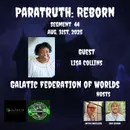
The Truth About Trauma w/Lisa Collins

 Apple Podcasts

 Spotify

 RSS Feed

 Amazon Music

 Castbox

 Deezer

 Podcast Addict

 Podchaser

 JioSaavn

 Spreaker

 YouTube
In this episode of ParaTruth: Reborn, Erik & Justin sit down with author, coach, and trauma practitioner Lisa Y. Collins to discuss her book, The Truth About Trauma: Break Patterns, Build Resilience, and Restore Joy. Lisa shares her insights on what trauma really is, how it impacts our lives in unexpected ways, and the simple steps we can take to begin healing. From breaking free of old patterns to restoring a sense of peace and joy, this conversation offers guidance and hope for anyone seeking resilience and renewal.
Bio: Lisa Y. Collins is a respected healing leader, life coach, STAR Trauma Practitioner, author, and assistant professor. Her studies focus on healing through a personal analysis of trauma.
Lisa’s consulting spans nonprofit and for-profit organizations, including local educational systems, the Association for Comprehensive Energy Psychology, The Shift Network, and the Center for Justice and Peace Building.
Her first book, Love of Light: A Guide to Peace and Oneness, guides consciousness, boosts self-awareness and provides tools for living in peace, and her podcast, Love and Light Living Every Day in Peace, focuses on positive examples of healing practices in the world.
As a playwright, she has had works produced in New York and Portland, and her acclaimed short film, Be Careful What You Ask For, serves as a platform for racial healing discussions and has been accepted into several film festivals. Her engaging TEDx Talk, “Healing From Racial Trauma,” also chronicles the healing modalities that resulted for herself and others from her research.
Lisa uses her spiritual gifts as an intuitive, spiritual writer and playwright to provide healing and openness that acknowledges the intersectionality of humankind. In addition, she uses her life coach and spirituality skills to give acceptance and space for connectedness and oneness in a world that needs it so much.
Find out more about Lisa's work at: https://www.lisaycollins.com/
Become a supporter of this podcast: https://www.spreaker.com/podcast/paratruth-reborn--6273542/support.
Thanks for listening!
0:03 Welcome, well, well do para Truth Truth, What's up everybody, and welcome back to a brand new episode of Paratruth Reborn. This is a pre recorded show on WINNO seven point seven FM in New Orleans and one O five point three FM on the West Coast Golf Coast. I believe actually got this dipo either way, it's on a coast, and of course the United Public Radio Network.
0:59 My name is there and I'm Justin. And look who's trying to give Justin crap for the script when he's just now coming back to the show. Just saying I'm just saying that. That threw me for a moment reading that, like, wait a minute, I didn't All right. I'll change it right now. I am mister scribac. Man. I leave for just a few weeks and everything goes to hell. Anyway, folks, I am glad to be back. I've been missing you guys, so I'm happy to be here. But today we do have a guest. We are going to be talking with Lisa Collins about her book, The Truth About Trauma. Lisa is a trauma practitioner, life coach, and author whose work centers on healing and resilience. She also hosts the Love and Light podcast and has shared her insights through theater, film and her ted ex talk Healing from Bradock from racial trauma.
1:59 Do not Disturb, Lisa, Welcome to Para Truth, We Reborn. How's it going tonight? Pretty good? Pretty good? Nice and calm? Yeah, awesome, So we got you on. Our show is absolutely one hundred percent of paranormal show, but we kind of tie this into you can have trauma from hauntings and stuff like that, but also the way the world is right now, so we wanted to have you on. Eric and I have gone through some major trauma this year, and we can maybe get into that a little bit.
2:39 But what inspired you to write this book? Great question, Justin I wrote this book because I was actively, actively healing from trauma myself, and I didn't believe in any of the modalities that are in the book. I just thought that's a bunch of hogwash. And I'm that kind of person, and everything in there I have used to heal my own trauma, generational trauma, psychic trauma, family systems. So yeah, I wrote it to share with other people. Okay, Well that was there. You just said there are a couple of different reasons why you wrote it, But is there anything particular, particularly personal in terms of your experiences that really just kind of hit the head of the nail that you said, this is the reason why I have to do this specifically.
3:38 Yeah, what floored me and kind of took my feet from under me is experiencing discrimination at work. And my grandfather was a sharecropper who worked until he had his own land, and I in you know, I was born in sixty five. I kind of thought I'm over it, and I thought that I wouldn't have to experience some of the extreme things I experienced. And what I end up doing is I end up studying those things for my doctorate and wrote a healing modality for that. And what I found in my work is that to heal any kind of other trauma, racial trauma, gender trauma, any kind of other thing, I needed to go and heal the foundation of all of it.
4:27 Yeah. So, how does your work differ from like other trauma and healing workers or even other books that have been written. Yeah, I know. My book is written from things I've done, and many experts out there that talk about trauma from a psychological point of view or mental health point of view are stating things that are best practice. And you know, even the Oprah and Bruce Perry book or they have stories this is like, this is what I've experienced, this is how I thought it wasn't real, this is how I actually healed it.
5:14 Okay, we know what that said. Like, who did you really write the book for? Is it for survivors, clinicians, family members, a mixed number of people, and how is it supposed to I guess is it supposed to help them through are their various techniques to help them through the trauma or is it more of like showing people that they're not alone? Great question. This book is for anyone like myself who feels like whether you've experienced something extreme because of what the trauma is, is your body telling you that there's a danger and that could be from watching the news, honestly, and so if your body is feeling like it needs to protect you from a danger or seemingly a danger, that's a trauma response. And a person like me who felt like, well, I don't think I have enough things to go to therapy or to do rapid eye movement.
6:07 I just like it's Okay, just shrug it off like it's not a big deal. Right, Those people, which I think is just everyone and our society has something that if you asked them about it today, it would needle them a little bit. And that's what the book. That's who the book is for. Okay, it's pretty fair. Like the one thing I noticed is a lot of people, myself included, you experience something something that's hurtful, and instead of just letting it go and releasing it and learning to work with it, you push it down. And the more you push this thing down, the more it develops, and eventually it becomes a trauma that you don't you're not even aware of until it's too late, and then you're spiraling. So I think it's pretty pretty fantastic that you have a book to help people like that.
6:52 Thanks, you know, who doesn't want to just stay in it? And our bodies, what interpersonal neurobiology tells us about our body is that our bodies are magnificent. They protect us. They kind of hide these things into a neuronet and the protector kind of stands outside of it. If something comes close to it. That's that knee jerk reaction like get your hands off me, and like I told someone like, don't ever touch me. I'm like, well they were they weren't harming me, but I don't remember anything, but my body sure does my body remember someone touching me like that when I couldn't answer back, And now I'm like, I'm going to answer back. And so for us to understand that, I don't think it's normalized anywhere that we talk about things like that.
7:37 Oh yeah, I mean even in like the paranormal community. The paranormal has was taboo when we were younger. It's a little more open now, but it's still a taboo topic that most don't talk about because it's you don't talk about that stuff quote unquote. So it's fascinating that trauma is kind of the same. Way absolutely like the paranormal. Like you know when people, you know, when I talk to people, I say, you know, there's only one world. There's not like the spirit world, and in this world, it's all one world. Then you could accept it or not accept it. But I would think that you can acknowledge what's there, like our minds have been crusted over not to and if we think about you know, the Martin Luther time why did those things happen. They happened because they said, that's not part of the church anymore, Like you know, that's wrong. And then you know, here we are today with a show like yours that's saying, hey, we want to know more, we want to know the history, we want to explore, we want to talk about something that could actually be a help to us or harm to us.
8:52 And you consider, like how much division there is just in the world in general, But then you bring things like this to you know, justin I being in this field trying to talk about trauma or helping people. Majority of people don't relate to us because we do come from a more supernatural background, in many cases a spiritual background, whereas people who are very spiritual, they tend to connect with us better and they able to help them in ways that maybe those who are not spiritual cannot. You know, we see this constant kind of a wall up between individuals, and I think what's really important is just as science and the paranormal were once one and the same and work together or both say science and religion, for example, that's something we need to come back to. We need to find a common ground and start to work with people on people level, on human.
9:44 Levels, absolutely, I absolutely agree. My first book was Love and Light, a Guide to Peace and Oneness, and it was about like spirituality, like people seeking and how do you seek? And humanity is is like that is the thing? I mean, you're naming the thing and what are the things that stand between us and each other and stand between us and all there is? And I think that's where we're at in our society today. And some people don't want to hear that, but I always ask people, do you want to be free? Yeah? Now we all react to things differently, medication, emotions, even trauma.
10:30 In your words, what is trauma and what is like how might one person from next look different when when they're traumatized? Yeah? Absolutely. Trauma is our body's response to protect us and from seemingly something that's a threat or not a threat. It could be a sound, it could be a gesture, it could be it could It can respond in laughter, it can respond in fear. And what we talk about in the field is like flock, fond, freeze and flock and fight. Of course flight, So you either run away, you know, I've experienced all of them. Either you want to fight, like Okay, I'm not standing for this. We're going to fight about it. Either you try to curry favor fawning with whatever you think the threat is, or I need to be in a group or a number of people flock like there's just power and numbers. And then it could also manifest itself in other ways that are seemingly under the surface, like deep belief systems, like when people talk about there's lots of coaching and stuff out there now, but the deep belief system, where did that come from? That you know I'm worthless or I'm nothing.
11:50 Right well, now, knowing what trauma is and how you define it, what are some common or maybe the largest misconceptions that people have about trauma. Yeah, I think one of the largest misconceptions is that it has to be something big. That was one of my misconceptions. It has to be a house fire, it has to be a loss of a kid or a parent, has to be a bad accident. But actually it could be spilling coffee on yourself on your way, or it could be something very small. And something small can can fall into a trauma response if something bigger, if your body is still remembering it years later, if you still have that gut punch or that twinge, you get that email from that person you don't want to hear from, like, oh, that's a traumal response.
12:45 Okay. Now, something you mentioned a little bit earlier was generational trauma, racial trauma. How does one go about recognizing that's what you're going on through other than like physical or emotional trauma? And how do you fix those things? Right? Well, we had a long road ahead of us, don't we just. Wow? Well, I can you know, share my own experience is that you know, these traumas show up, you know. I what I talk about in the book is like Grandma hides money everywhere. You know, Grandma lived in the Great Depression.
13:26 So now I think that I need to hide money or I need to you know, hoard money. So sometimes that I talk about in the book is how do things show up to you that are not right sized? Right? So one thing, for example is in my family all have deep freezers. And when I'm married, I said, we need a deep freezer, and my spell said, why we have two refrigerators. I don't know why we need a deep freezer, And I said, because we need to put food in it. We cannot eat that much food, and I have to think about, like why do I want a deep freezer? And then I realized everyone in my family had a deep freezer on my mom's side and they grew up on a farm with ten kids. And I thought, oh, that is not mine. I think I can put that.
14:15 Down well, and I think we all kind of have no type of thing. There's plenty of things that I still do that, but you know, I grew up with that. My parents said, and I'm the same way, like I should have this, and you have that. And then I realized, wait, but that's not me. I wouldn't normally have that particular item or you know whatever, but because everyone else had it, I should have it too. It should keep it like a tradition, even though it's not necessary. Right, And I started pulling on the thread a little bit of like why is this? Is this? Why is this in my body? So when we talk about generational trauma and we talk about epigenetics and stuff like that, there's things in our bodies how we think and how we look at things that may have been passed down.
15:04 And I think racism is a really good one because of you know, the Indigenous people being in the United States first all actually all over the world. It's not a United States problem. I mean, there's colorism, there's casts and so. And for me as a black woman in the United States, like sometimes I find myself bristling over things that I've just been indoctrinated by the media. And for me to just like be curious is what I say in the book. Be curious about things that seem a little off and be willing and the universe kind of opens those things up for you to heal them. Okay, And you know, you bring up racism racial trauma, And I have been saying this for a very long time.
15:51 We're all one race. We're the human race. We just all come from different ethnic backgrounds. So for that word to even still be around is the most ridiculous thing I've ever heard, just because I grew up accepting everybody. Our grandfather taught us to accept everybody. It doesn't matter what color skin you have, what color hair you have, if your eyes are blue or brown like. So, I mean, yes, we have to heal from all this trauma that has been done prior to us existing, but we need to eliminate that word completely out of our vocabulary. To even come close to healing that trauma too.
16:37 I would like that very very much. And one of the you know things that happened when I did write my dissertation is I wrote a healing a healing model, and the healing model is about like when you're not okay, Eric, I'm not okay, like when I you know, like that is who I am. And the more that we are all like that, then I think that humanity can show up. But we're not right because we have institutions in place, and we have oppressive practices in place that separate us. But once our hearts are open to know that if my brother suffers, I suffer, then we are so much closer to the to the ball absolutely.
17:27 And you know, I feel like people just with our modern civilization, you know, we have phones that we're just constantly staring into, around computer, social media, everything else, people become so disregarded to the space around them and the people around them. They put up these walls that maybe they don't even mean to. You know, we should all be empathetic towards them one another, be sympathetic toward one another as well. But time and time, and I'll admit I'm guilty of this at times where someone's having a bad day and I'm like, oh, I don't want to deal with that, Like I've already had my own troubles, and that's not always a good thing. Like they might need our help, and likewise we may need them, you know, someday, you know. And it's just one of those things where I think it isn't easy. Obviously it isn't easy, you know, never be easy, but everyone has to take the opportunities to bring down their walls, open their minds and their hearts to the individuals around them. Because helping someone else, in my own personal experience, this is a very much, very much similar way to helping myself. Like I help someone, I kind of help myself. I lose my own you know, morale if you will feel better, And it's like I'm not just going out helping people to make myself feel better.
18:41 But it's like that that common ground. It's like you lower yourself a little bit and suddenly you're standing on the same ground as somebody else and they're lifted, you're lifted, and you move on together, you know. But it's sad that we have so many people with so many walls up and who are just so disengaged with civilization and the societies that you know, this has to be a conversation. Right, And I think that we're probably doing better than we think we are, but we're so isolated, Like, I don't know you, gentlemen, I'm just meeting you. I'm grateful for the opportunity to meet you. And there's probably lots of people who are isolated from people, from like people.
19:28 And that is one of my dreams is in every city that we have a community of support where people can come and be with other people and be accepted and be heard. And we really need that. Right one hundred percent. Yeah, Now, in your own words, you've kind of touched on it a little bit, But in your own words, why is it important to normalize conversations about trauma? I think, you know, we I'm like myself. I thought it was just my experience. So when I went to learn about you know, I accidentally learned about it. I don't think it was an accident. And I learned that my body is responding and that my breathing gets shallow.
20:13 I just said, that's not true. Until my breathing was shallow, and I had to tell myself to breathe. I think right now, especially right now, that we all need to like center and ground and know who we are. And part of who are not is whatever trauma we've experienced either generationally in our community. We're not that. And I think right now we're really spinning and thinking that we are that. Right. I would love if we could as a people just put some of these backpacks down and lean in together. So I think it's like vital in any healing to like get to the core and said, hey, that thing that happened to me when I was five, I'm going to heal that. I'm gonna, you know, work through it.
21:04 I may even do forgiveness. I'm going to work on my energy. I'm going to make sure my boundaries are clear. And I would love to just like lean in and maybe pull somebody else up and struggling. Right, Okay, Well, you know, and like one of my favorite things to do is a little something known as shadow work, and it's basically, you know, finding questions or asking questions about your past and answering them very honestly just to yourself in a journal. And I've learned so much about myself and my own personal traumas that do get triggered on a regular basis. You know, somethings I didn't even know about until the question arose and I was like, oh, I remember this time, you know, And it's It's something that I was trying to encourage people to do because I think it's very important, especially if you know, I get it, and everyone is interested in going to a therapist and sharing their lives of somebody else.
21:56 You know that. I understand that I'm one of those. I don't like it. I've done it many many years and it doesn't work for me very well. But when I'm writing in the journal and I'm teaching myself and showing myself the truth, well, now I'm able to take steps to better myself and to fix those traumatic you know, those traumatic things that happened. So yeah, I'm a huge advocate of journaling. I think that's really for any of you listening, everyone listening. If you don't already do shadow work or journal, you should definitely do that because I think it's highly beneficial for your growth. I agree with you, Eric one hundred percent. And actually the book is kind of set up as a journal where in shadow work is in it I learned that in conscious Freedom life coaching I'm a life coach as well, is that I was shocked at what was in the shadow.
22:47 And there's actually an exercise in there called the thinking Map that just gives you, step by step, something that's bothering you today, and you can just go through the there's throwly three steps to get to the shadow. And go through those three steps, you know what's going on, How do you feel and how what is the deep belief about yourself right? And then is there anything that happened in your past that you can remember that would have you to believe that? And that I can't tell you what that did to me, Like I was shocked, Like, oh, it's about that.
23:27 You know. It's crazy because you learn these things and sometimes it's not easy, like sometimes there's only these things and it's hard to get through and it takes It's not like you write this journal and then boom, you're done in an hour session Like this is things that you have to unpack sometimes days, weeks, months, years, depending on how deep it goes. But every step is a step forward, or at least it should be. And I think that's one of the things I like most about it, because you can't fix something unless you know about it first, and even though it might hurt to know, it is very beneficial. In forward, Yes, I felt like I wasn't alone, and I feel like I'm not alone period because I have guides that'd work with me. But that The Truth about Trauma book is like a journal that you just tag ear mark highlight, just kind of like go through it, and you know in the back or the tools behind every chapter self care tools, affirmations, meditations, and then in the back of the book you can see like where is that thing, where is that shop or healing? Where is that root work? And so I feel like it's made for a person like me who doesn't believe in anything and who questions everything.
24:40 Okay, Yeah, now I mentioned earlier that Eric and I have both gone through some pretty bad trauma this year, one of which being we both lost pets very dramatically, eric more recently than I have of But what are some of the first steps someone can take to start realizing that they're experiencing trauma? Yeah, I'm so sorry to hear. Like pets have been a theme this week, and as a spiritual medium, I can you say the names of the pets that you've.
25:24 Lost, Foxy and Salem. Okay, yeah, okay, those are the two names. Sorry, Fox his dog, Salem is my cat. Well, thank you so much for sharing that with me. I'm really sorry for your loss. I think the first thing when people or animals cross over, they're not gone. They're still there. Like I don't know if you've heard them or if you've felt them, but I I know that that part with you two will be a little easier to talk about, is that they're not in this realm, but they're still present, right, And the other part is to continue to have contact with them, like I'm talking now, not as a trauma practitioner, but as a spiritual medium to you know, still talk to them, still write to them, you know, and eventually you will be getting messages from them, you know. I know that, you know, we had a beloved cat who I can fill jump on the bed sometimes, like all of a sudden, there's like that very distinctive cat jump on the bed and nothing else is there that you can see. And I think those things are part of it. And then the other part of it is to allowing yourself to actually grieve but not fall
26:54 into the grief and then to work on some kind of healing or moralization. And you'll see that in the book too, like memoralization of your pets, Like how do you want to memorialize them? Because that's a big part of the grief process and the trauma healing process. And then you move into that acceptance later. But I think when you have contact with the spirit world, then you have like the beautiful chance of uh you know, having a reading and talking to them or feeling them in your house or feeling next to your leg. I came in this room the other day and heard the biggest MEU. It was so loud, and I thought that I said, there is a cat app here, and my spouse was like, no, no, and I said, well, someone was here. I mean it was loud, very very loud. And I was like, okay, okay, someone is here, and so you know, don't discount those things.
28:00 Okay, thank you, You're welcome. I hope they come. If they come, I'll tell you they may. Sorry, I kind of lost my spot here. We have like a list of notes that we follow to help guide us. We used to be really bad at keeping our heads straight in the middle of conversations. Wait, where were we going with this? I had another question? I can't remember it, but uh, oh goodness, I'm sorry. Apologize number twelve If that helps her? Oh that does help? Thank you? H So how would you how or asould you say? What role? I guess does community, therapy and self care really play in the healing process? Because I know, like myself, when I become depressed, when I'm especially like with my cat passing away last week, it wasn't unexpected, but it was way sooner than I did expect it. And when I'm depressed, I can't eat, I can't sleep, I can't I really can't do anything.
29:11 I can't bring myself to do anything. But I know it's important to take care of ourselves, to take the time to get outside, to get in the sun. But what are some other ways? In what roles do these type of things? Is self care or therapy or community really play in healing overall? Yeah? I you know, what I believe is that there is a time and place for everything, and part of it is like allowing yourself to like listening to your body of what your body is saying it needs. And we know what I know is when grief happens for me, or when I am turning, I call it turning the screws inward, where I'm just like really shutting down and getting into that into that hovel, into that cave that I can't stay in there. And one thing that always reboots me as there's a couple of things that I keep in mind. I call it my toolkit. So find out what's in your toolkit. One of mine is music.
30:07 Music brings a lot of joy and can just change your attitude and your feelings right away. Not sad music that time, but listening to music that kind of brings you joy. The other thing is going outside, putting your feet on the earth is a good way to kind of ground and make sure to you know, ask the earth to take away the things that you no longer need and fill you with the energy that you do need. You'll fill that energy just come right up through your crown. And another thing being in nature of course. And another thing is like to make sure that your bound your energetic boundaries are really really clear and tight and you know, and shockwra clear. Working on those chakras if this root chakra or whatever chakra's blocked. And in the book we talk about I talk about that like looking at those chakra those are energy centers to make sure they're clear.
31:15 Is another way to just to help breathe in a little light, just to catch your breath a little bit. And then of course breath work is really really just it just sues and just takes care of you. Those are a few. Now we do this all the time just because we're taught to deal with trauma a certain way. But how can friends and family best support a loved one going through trauma? Yeah, you know, recognizing that it's trauma. That's another reason for like Eric had mentioned, community and is like is recognizing when someone is in a trauma field, right, And when someone falls into a trauma field, they typically may be saying the same thing over and over again. They may tell you the same story over and over again.
32:15 I call it scripts, and that means that they're in a trauma field. So trying to explain to them at that time or trying to reason with them to know this is what's really happening, is not really helpful. To recognize when someone's in trauma field and to co regulate with them, So that's being in the space with them that's being close to their body but not necessarily touching their body. And one thing you could do is attunement is ask them, you know what's happening for them, and where do they feel it in their body, having them put their hands on that place that they feel that, and then you mirror and also put your hand in that same place. And this particular activity, I did not believe it was going to work, and it did one more time I was proven wrong. And that attainment is a really it's a soft gaze. It's nodding. It's not dismissing.
33:15 Even if they're saying something that doesn't make sense, it does not to dismiss it. We do that a lot. Is we dismiss just not and be there and you will watch the shift with them. Well now is also going off of that, like in your research and experience, what approaches the healing tend to be most effective long term? Yeah? I think long term is is actually for people to like not do the like band aid thing, like you know, put a band aid on, I feel so much better. I'm done. And like you had said, Eric, it's like it is a depending on what you're experiencing or what you're doing dealing with It's not like a one time like I'm going to do it and I'm going to be free and it's going to be over.
34:06 It's that maintenance step of In the book, I talk about the body, the mind, the spirit. So paying attention to your body, getting to know your body really well, having a relationship with your body, and then looking at your mind patterns, what are you thinking, what is your garbage coming in that you're paying attention to negative thoughts that you're romancing, and then how to change those thought patterns to be more healthy thought patterns. I used to think, Oh, everybody thinks like this, this is like this running diatribe that's in my head. Is that's what everyone's having? But no, not really no, And now my head is peaceful, it is quiet. And then your spirit, then your joy, like what are the things that bring you joy? And those three things are the cycle of longevity in my experience.
34:56 Okay talked about how writing this book has impacted your own life and your own healing journey. But did you learn anything surprising about yourself while writing the book? Uh? I think the hardest part for me was writing the family systems. Like in the back of the book. I touch on a few things in the last chapter family systems, gender, race, sexual identity, and the family systems part. I just remember, just as I was starting to write it, I just start and during throughout the book, I share experiences from my family, and it was just hard. It's hard. It's hard to acknowledge the truth. It's not like you're going over to mom, dad or grandma and saying, hey, remember we did this thing that was horrible. It's me acknowledging the truth and me healing it within myself. And I just want to pull the blinds down of unfortunate experiences or things that I did not like or enjoy that harm me, and me being honest with myself and saying okay, and me being honest with myself for you the reader, so that you can say it's okay to say this stuff happened. It's just about healing it for yourself and moving on, not about going back and you know, holding court with other people. I think that part, that part
36:29 made me pause for a minute, and I and I got the nudge like, yeah, you're gonna write it. You're gonna write this down. It's gonna help people. Yeah, Well, I think that that's it's really hard because as people, we we want to hear the apologies from individuals who've heard us. And so often it's in my own experience, I want to say often, but in my experience I've had there's been things that happen where I try to bring it up to someone who's hurt me and try to show them where they wronged me, and they never see it. They can't see it, they don't think they did anything wrong, and in that case, you never get the apology, and so it's hard to find the closure and the healing. But yeah, as you said, you know, it is something which I'm still learning that you have to do is just like internalize it, understand it yourself, and then forgive it without hearing the apology, because you simply come, you know, you just can't move on Otherwise.
37:23 Yeah, it just lives with you. And I didn't want it to live with me, so I had to humble myself too, you know. I talk about it in the book also like a forgiveness protocol, and the forgiveness was for me to be free, and so I looked at what, you know, what they did, and then I also looked at how I was holding a resentment against them and I and you know I did all of this in writing as a writer. I may on my journal right here. I mean I asked myself, I asked for forgiveness for myself, and then I said, and I forgive you for these things. And I'm asking forgiveness for me with these things because I want to be free. I want to be free and I can help other people if I'm holding on this stuff, so I'm a conduit for healing. I have to let it go.
38:19 And I will say, I want to add for our listeners. Sometimes it's not easy to just let something go mentally. Sometimes you need a physical thing to let go of, something you can see. And so that's where like cord cutting or burning of paper comes. If you write these things down, you forgive and you forget. You like that little sheet of paper on fire and let it burn away. And that's just the manifestation in your own, you know, your own life, of that disappearing and letting it go. And I think that's for me that works really well. I'm a very visual person, you know, sometimes internally, especially since I so I have obsessive compulsive disorder, and so I constantly have an onslaught intrusive negative thoughts, and it's hard for me to get past those at times. So whenever I try to think something positive, something negative is like nope, get out of here, you know. So having those physical elements to try to help me navigate and help me to really imagine and see myself letting go something is important. And so for those of you out there listening, I think if you struggle like I do, that is those are two very strong options. There's a number of ways to do it. But does it always worked for me?
39:34 Absolutely? And I have done both both of those actually, and so yeah, I totally agree with you Eric. If you're out there and there's no like, you do it. It's not like school. You do it and oh you got an a. It's like, really, the heart of the work is your intention and walking and do what feels good to you. Like any of these things are suggestions, but whatever feels right for you, do it. And you know, I've also worked on the intrusive thoughts, Like I worked with a healer and it was like lifetimes and lifetimes ago of working through you know, I was like, but I was so grateful there was someone that you know, was was could hear me and help me?
40:25 Now, what societal changes do we have to do in your opinion to better support trauma survivors. I think we're all trauma survivors, So I think the better support all of us is that we need to we if we could have places like your podcast, I'm going to start a podcasting the Truth about Trauma, places where people can get information and then eventually start to gather, like either we're gathering online, and I think for us to be able to recognize when someone is acting in, that's depression workholism, that's the shock that happens when a trauma happens. You're either acting in or acting out. And seeing how people can go from one recognizing trauma responses is the second one is how are we as a community going to gather to support each other? How are we going to bring our nervous systems together, whether that's online or in a space. You know, people used to go to church. They don't really go to church anymore.
41:37 Love and Light talks about that we really need to gather in our homes or however we need to do it, like people to gather. This is a call to action for us that are isolated out there to come together. I think that's one big one. And then to have a relationship with your body. When your body is telling you something is too much to soon just stop and pause for a second. And we have this go go go society that makes us take on a million different things as we're doing media posts as we're and I just like I have to say to myself, like, this is great abundance, but I need to slow down. My body is saying slow down. This relationship with our body is vital, and then our mind and our spirit will connect.
42:23 And so I would love, like it is my intention to see places like that in every city and to have people gathering to practice being together so that we as a community and society can heald Well. I kind of want to spin off of that and ask you for those people or anybody who maybe doesn't understand or doesn't know how to have a relationship with the body to understand where it's trying to tell them, what are some uh, some things that you can do to help yourself to help you better understand what you're by you. No, absolutely that would be me, the person who did not know on an a a relationship with their body I think the first thing I started was trying to quiet my body, trying to quiet my mind. I did like a walking meditation. So people's like, oh, just meditate, and I'm like, the first thing I did was I would walk and I would either listen to a book or listen to something, and I would try to just clear my mind. I would just so that the thoughts were not just running, running, running through my head, either listening to music or listening to a book on tape, and finding a way to bring that body piece and to ask parts of your body to relax, ask the top of your head to relax, like to sit quiet, even for a minute. And you know, the back of the book, every chapter has a meditation. Meditations could be
43:53 anything that feeds you, anything that feeds you and quiets you. And after a while you will start to get body sensations like you like sometimes, like when I talk about the email, the body sensation of like oh it's Joe again. Like those body sensations you want to start to pay attention to. I learned to ignore them, Like when you're hungry or you got to pee, You're like, oh, I don't want to go right now, Like those are body sensations. So start paying attention to body sensations and pausing with that, Oh, I'm hungry right now. And I've even got to the point where I got it from the dinner table when I was hungry and I was like, oh, why is my stomach growling right now? That's when I realized, Oh, my body has learned to eat food for comfort. So I was having a hard time and my body wanted something to eat, I just ate. So I taught my body how not to do that. Like, we're not going to eat again. But listening to those body sensations is the first first step. Okay, I'm quieting the mind. It's your body.
45:02 Now. If there's anything that someone can take from reading the truth about trauma, in your opinion, what would you want them to take from it? I would want them to take that everyone can live in peace, so you don't have to struggle and you don't have to suffer, regardless of what has happened to you. Like you may need additional help, but all of us who are have lived with childhood trauma, who have lived with losing people or animals, you can live at peace. You can have a peaceful life, You can heal.
45:51 Is that would you say that? That is kind of like, if you have the opportunity, that's the message you would want someone who's currently suffering listening to this show right now to take away, or there's something more you'd maybe add to that. I would want them to take away that there is hope, and then I'm an example of hope. I've lived through a lot of stuff and I have a good life today. I feel free. I want them to think that the people care about them and love them, and that there's hope. Now, that's something we're lacking these days, is hope, Not that there isn't any just feeling that hope. So I, as someone who is working through a lot of things myself, it's something to definitely grasp for sure. Now, there's obviously your book as a resource for people going through this healing journey. Is there any other resources you would recommend? Books, practices, communities, podcasts, even.
47:09 Yeah. I think one of the kind of the primer books that I mentioned in my book is There Is Nothing Wrong with You by Sherry Hubert, and it is a good book to start with because it works on the thinking in the mind of you know. She starts with there has to be something wrong with me or else people wouldn't treat me this way. And it's an easy, easy read as kind of written like a comic book, and I think that is an excellent place to start. The other place that I got my beginning is with the Center for Justice and Peace Building and the Strategies for Trauma Awareness and Resilience, which was founded after nine to eleven as a way of healing. And that model is the model that I that I put my racial experience on top. And it's very very clear. You can go to Eastern Minnonit University Center for Justice and Peace Building and the models are right there. They're free. There's a free download. There's a free download on my website of Love and Light. I mean, those are touch points to start, all.
48:26 Right, Well, thank you for sharing those. So you had mentioned that you are starting the podcast soon. But what else is next for you after this book? Are you working on any other future projects or continuing the conversation in any new ways? Yeah, I was. What I'm percolating on is I'm also a playwright and I have one film, and I've used writing and playwriting and as a way of healing. And what I have in My craw is that I would love to take a few of my one act plays and put them into films for talking points about different topics.
49:11 One of them is sexual trauma sexual abuse for kids. That sounds kind of heavy, but it's a very lightly written and it rewrites the narrative for family member that has passed. I've used that vehicle for that. So I'm also thinking about doing, of course, the podcast, but I'm also thinking about maybe doing another play, kind of like taking some of these themes and putting them on stage and having some talkbacks. So those are a couple of things I'm thinking about. Cool. That's really cool. Yeah, that's awesome because Eric is a cinematographer I wouldn't even say just a screen writer, but also he is has filmed some of his own movies. He's worked on tons of things this year alone, let alone in the West.
50:08 I'm a self published author, so it like, do you feel that being a creative helps with dealing with those things? Absolutely that, you know. The one that I wrote for my aunt, it just for me. It helped break the cycle in my family of this like invisibilized thing that no one was talking about. And I rewrote the narrative where she was empowered and spoke up and made it different for her. So to me, that helped heal. Like generations of trauma and no one ever said, hey, we have generations of sexual trauma in our family. But I get it. I've experienced it, and I'm like, the book stops here. I We're gonna stop the book and I want the energy to go in another direction.
51:01 Well, so we are actually running pretty close to the end of the show here. But what we'd really like to offer you is the opportunity to just tell everybody where they can find you, where they could pick up your book, and of course sure any other information you'd like to share. Yeah, thank you, thank you for having me on the show, Justin and Eric, it's been a really nice talking to you. You can find me at Lisa Wycollins dot com. You can find me at Lisa Yavetta Collins on Instagram. I'm even trying some TikTok nowadays. I have a YouTube from my other podcast, Love and Light. But I'll be starting another podcast, the Truth About Trauma podcast, coming up probably next month. And you can find my book, The Truth About Trauma wherever books are sold. Llewellen is the publisher, and yeah, I think that you can find my work is out there. My website's a good place to connect with me. And please write, Please write if you have questions. Right, I'm here to help.
52:02 That's awesome. All right, Well you hang in just for a minute. I'm gonna put you in limbo. We truly appreciate you coming on, but we're gonna give you some more information once we close out the show. So hang tight, all right, folks, make sure you check out Lisa collins book The Truth About Trauma. Absolutely a great resource. Obviously, not only can you read about the different modalities that she talks about and how to deal with it, but also journal through it. Any last thoughts. No, you know I always say no and then I say which means there's something, there's something. Why I do that every week? I think I'm just still used to saying no. So you know, no, you know, whatever you're going through, you know, whether emotional, spiritual, et cetera, we're here, you know. We always actually guys to email us, reach out on social media, talk to us some way. We're here where we're really interested in listening and learning and helping you go through whatever it is you're going through.
53:12 And also if you want to reach out to Lisa Collins and you can't forever reason you can't find her, you don't know how to go about it, feel free to reach out to us. We're very accessible and we will get everything you would like to her and be that kind of mediator in between if needed. But other than that, you know, man, it's getting like permit August, getting to the end of August, like it's almost. Halloween, almost spooky season. No, it's our favorite time of year, y'all. Yeah, And I've got two great shows for the end of October, so definitely check those out as soon as they come out. We got a lot of other great stuff coming up as well. We've got Factor fiction about both the Permuter Triangle and a couple other things. We've got a lot of great guests coming up, so check out everything we got going on. Make sure you like, share, subscribe wherever you listen or watch. You can find us on YouTube on our channel or the UPRN channel, Spotify, iHeartRadio, you name it. All you do is type I Paratruth and you're gonna find us. But again, this has been a pre recorded show on one oh seven point seven FM New Orleans, one oh five point three FM on the Gulf Coast, and the United Public Radio Network. Make sure you're checking out all the rat shows that are on UPRN. There's tons of them, but until next week
54:48 where you'll find us, same time, same channel. My name is Justin and I'm Eric Base. When your between


