
The Bloody Road To Castle Dracula: The History Behind The Legend w/Steven Rolfes
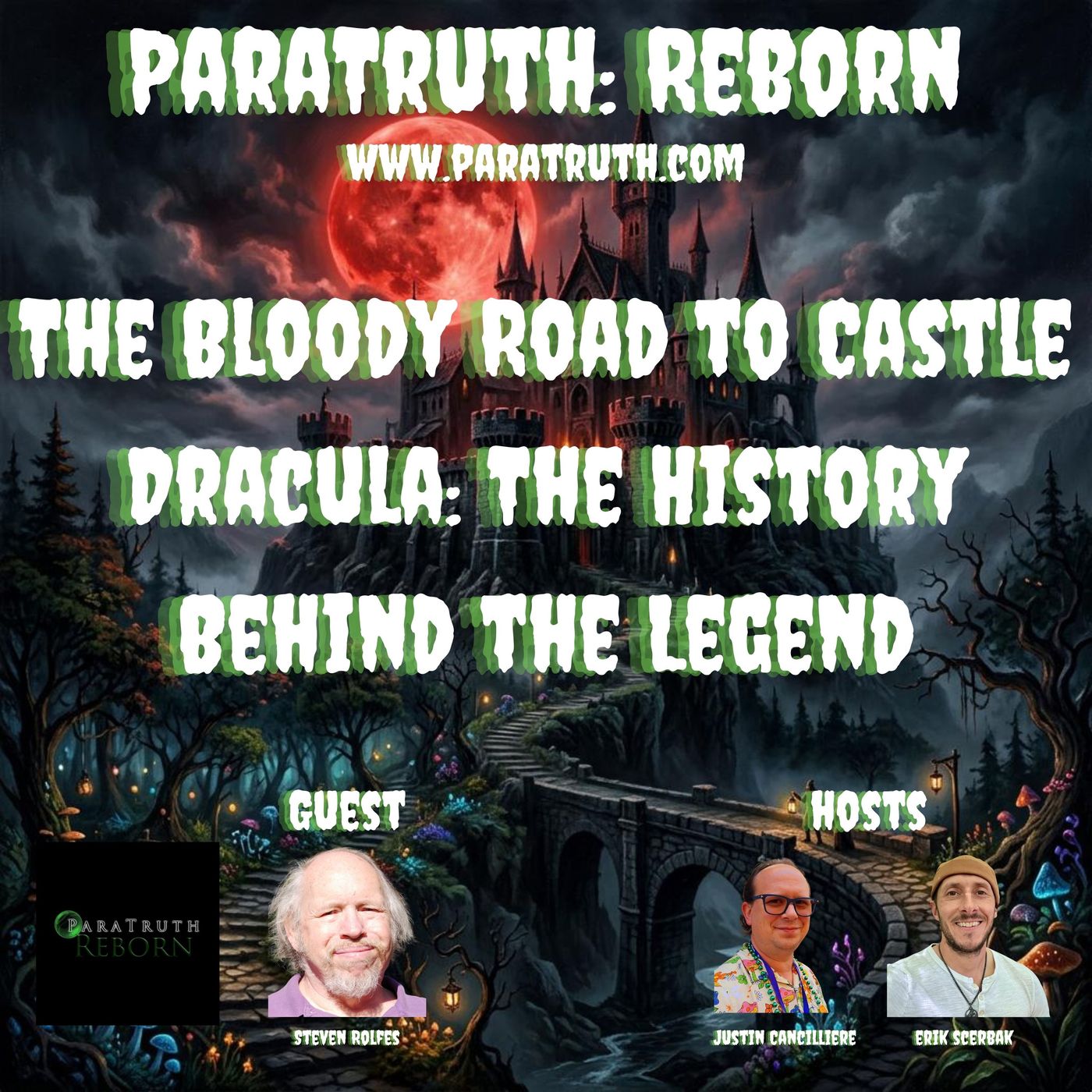
What really inspired Bram Stoker's Dracula? Before Dracula became the world's most famous vampire, centuries of folklore, history, cultural fears, and strange historical figures helped shape the legend. In this episode of ParaTruth: Reborn, Justin...

 Apple Podcasts

 Spotify

 RSS Feed

 Amazon Music

 Castbox

 Deezer

 Podcast Addict

 Podchaser

 JioSaavn

 Spreaker

 YouTube
What really inspired Bram Stoker's Dracula?
Before Dracula became the world's most famous vampire, centuries of folklore, history, cultural fears, and strange historical figures helped shape the legend.
In this episode of ParaTruth: Reborn, Justin and Erik welcome historian and author Steven J. Rolfes, author of The Bloody Road to Castle Dracula: Explore the History of Vampires & the Inspiration Behind Bram Stoker's Masterpiece.
We explore:
🦇 The origins of vampire folklore and ancient superstitions
🩸 The real historical figures associated with Dracula
📖 The writers and stories that influenced Bram Stoker
🏰 The historical mysteries surrounding the legendary Count
🌋 The unlikely events that helped give rise to gothic horror
🎬 Why Dracula continues to captivate audiences
Is Dracula simply a work of fiction, or is there something deeper hidden within centuries of history?
Join us as we explore the fascinating line between historical fact and supernatural folklore.
📚 Find Steven J. Rolfes's book:
https://www.llewellyn.com/product.php?ean=9780738782904
🎙️ Support ParaTruth: Reborn:
https://www.spreaker.com/podcast/paratruth-reborn--6273542/support
or
https://www.patreon.com/cw/paratruth
👍 Like, subscribe, and share if you enjoy paranormal history, folklore, and the mysteries that challenge what we think we know.
Question for the comments:
Which do you find more fascinating: the historical Vlad the Impaler or Bram Stoker's fictional Dracula?
Guest Bio: Steven Rolfes is an author living in Cincinnati with his wife and two children. He has written ten books ranging from history to the paranormal and folklore. He hosted a radio show where he told ghost stories and volunteered as an E.S.L. teacher for many years. He retired from the Southern Ohio Regional Transit Authority, and in his free time, he plays guitar and travels.
Thanks for listening!
0:00 Coming up on Paratrooth Reborn, I'll be talking to Stephen Rolfes about his book, The Bloody Road to Castle Dracula. Welcome to Paratrooth.
0:42 How's it going, Paratroothers? Welcome to another episode of Paratrooth Reborn. My name is Justin, and this is our official Halloween episode. And we are so excited to bring something a little bit different to y'all. Tonight we're heading down a dark and fascinating road, one filled with ancient folklore, mysterious historical figures, chilling legends, and of course, one of the most famous monsters ever created, Count Dracula. But what if the story behind Dracula is even more fascinating than the novel itself? We're separating fact from fiction, exploring the origins of vampire lore, and discovering just how the world's most famous vampire, came to be with our guest, Stephen Rolfes. Stephen, welcome to Paratruth Reborn.
1:36 Thank you. I'm delighted to be here. And happy Halloween. Yeah. Our favorite time of the year, of course. But now, before we get into the book, you've written about so many different things. History, paranormal, history. What sparked your fascination with folklore and the darker side of history? Well, I was a perfectly normal child until I was five years old. And then my mother took me to see Fantasia. After that, that was it. I'm done. I've been into the paranormal and the weird ever since. Okay.
2:20 So what made you want to write? The book, The Bloody Road to Castle Dracula. One of my favorite novels of all time is Bram Stoker's masterpiece, Dracula. In fact, I got my first copy, like I say in the introduction, when I was about nine years old. I've read that thing so many times, it literally fell apart in my hands. And that's the way a good book should be, in your hands, not on the shelf looking pretty.
3:02 So reading that book and then starting to study history, I'm sure that you've probably been asked this question, and a lot of people think of When you hear the name Dracula, you think of, you know, the vampire, you know, the fictional character. But how does the story differ from actual history? It is different on some very major elements. The actual cases of vampirism throughout history involve vampires. what is called a revenant, a dead body that returns and it feeds off of the living. Sometimes it comes in in a ghostly form and will suck the blood or the breath of the living people, usually the person's family. You look at the Bram Stoker's masterpiece, Dracula, and he is something very different. He plans an invasion of another country. He learns a foreign language. He studies maps of London, and
4:34 he manages to get himself shipped in his boxes all the way to Whitby. So no actual vampires would ever do anything like this. So Dracula is actually a combination of both vampire and a devil. And when you look at how the final inspiration for his character, you can very easily see why. Because Stoker based this, or he was finally really inspired to write it, when he saw his employer, Henry Irving, the great actor of the day, portraying Mephistopheles in Faust. Now, this was a monstrous production, and Stoker's job was to put it all together. And when this came on, this was like a Pink Floyd concert in the Victorian era. There were hundreds of extras on the stage, devils dancing about and witches dancing with demons and overhead dancers. There were witches flying on broomsticks
6:06 and music that I would love to have heard. It must have really sounded like Wagner on steroids. And out of that, through a cleft in the rocks, came Henry Irving as Mephistopheles, dressed in scarlet with a sword at his side and a big feather in his cap. laughing at all the madness. Now, in the back of the theater was Bram Stoker. He always stood in the very back, and he wasn't watching the play. You know, he had seen that in rehearsals all over. Now he's watching the audience, and everyone in the audience is jaws wide open, eyes staring, no one said a word. And then Stoker looked up and he saw it. And he was captured by the spirit.
7:09 And he saw his employer, Henry Irving, standing there as the devil himself. And at that point, Stoker knew, now I have my vampire. So Stoker really created... What we know today as the modern day vampire, then it wasn't this thing that was intelligent, per se. It was something originally the vampire was something that just came back to life to feed. Right. He was not the first. And that's, of course, what my book describes. The original working title in my book was The Twisted Path. to Castle Dracula because this story goes from one place to another to another, but they are all connected. The very first one that is in this little snaking route was Lord Byron, the famous poet and hedonist. He had combined with his companion, Dr. Polidori, and they went to Switzerland. Actually, Byron was fleeing England
8:42 because he had a lot of creditors who wanted his head and a lot of jealous husbands who wanted any part of him they could get. Well, when they went down there, He had an admirer, a young woman named Claire Clement, who was the half-sister of Mary Godwin. And she was in love with the poet Percy Shelley. Now, Claire Clement told Percy and her half-sister Mary that oh, you want to go to Scotland to see mountains? I'll tell you what, this Napoleon thing, that's taken care of now.
9:36 We can travel in Europe. Let's see some big mountains. Let's go to Switzerland. And they all wound up together in Switzerland, in Geneva, at a place called the Villa Diodati. Now, the weather was horrible. You see, a year earlier, and I have a whole chapter devoted to this, the volcano Tambora had erupted. And this was not just any ordinary volcanic eruption. This thing made Krakatoa look like a firecracker.
10:23 And it was so powerful, it changed the weather of the entire world. The entire globe was opposite of the way it should be because of the volcanic material in the stratosphere. And one of the things that it did was that it caused rain, rain constant and cold and wind and storms. And this was in Switzerland. So the group of five, Claire Clement, who pretty much steps out of the picture at this point, Percy Shelley, Mary Godwin, Lord Byron, and Dr. Polidori are all together in the villa, and they're reading ghost stories to each other. And they're reading from something called Fantasmagoriana, which you can still buy, but I don't recommend it. Read the stories online because they're not that good. But one night, they decide to read Samuel Coleridge's vampire poem, Christabel. And if you love gothic vampire poetry, you've got to read Christabel. All of
11:54 a sudden, Percy Shelley, for lack of a better term, he literally freaks out. He starts screaming. He goes running out of the room. Dr. Polidori runs after him, finally gets to do something medical, and then Lord Byron is sitting and just laughing like crazy. They were all a little weird, and especially Byron. Well, as it turns out, when they got everything settled down, Byron said, the heck with these stories. We're smarter than this. We'll write our own ghost story. And everyone was all happy with that.
12:40 Mary Godwin, of course, wrote the first drafts of what would become her novel, Frankenstein. Because later on, she married Percy Shelley, and she became Mary Shelley. And incidentally, just a real quick aside, I talked about the weather and the volcano. You notice that so much of the novel, the actual novel, Frankenstein, takes place in the Arctic. That is because of the volcanic eruption. Lord Byron, he had no idea what to do. He came up with the idea.
13:27 But now, I don't have an idea. So he starts to write a vampire story. And you can still read it today. And it's wonderful. It is intriguing. It's got characters that you... really want to know about, and then it just stops right in the middle. Apparently, he set it aside. He probably talked to Polidori about it. Yeah, here, look what I have. I have no idea what I'm going to do with it. And that was that. To this day, one of the greatest vampire stories of all time has never been finished. Wow. And from there, it went to Polidori. and he wrote a little novel called The Vampire, which is not really good writing, but it became very, very famous. Two years later, Polidori died, and his story, which he never got to see, became a sensation throughout all of Europe, every theater, especially in Paris.
14:43 They all had their own version of his novel, which was stolen from Lord Byron. And eventually, this came to another theater man, and that was Bram Stoker. And he decided, oh, this is a great, great play. I've seen versions of it. Even Alexandre Dumas had a version of it. I'll tell you what, I'm going to write my vampire story. And then when he saw Henry Irving on stage, I know exactly what I'm going to do.
15:30 That's amazing. So something that I've weaved, research over the years is like all these different things about why people suspected corpses to be vampires or those that would be rising from the dead and whatnot. Through your research, have you found the actual reason why people were thinking that the dead would rise and prey on the living? Yes, because they were seeing them. For example, look at the case of Arnold Paole in the 18th century in, I believe it was Serbia. And he had gone with the army into Greece. And there he had some kind of confrontation with a vampire. He was able to destroy it.
16:36 But then it seemed to be cursed on him. He died as a result of a fall from a wagon, which should not have happened. He was working on the wagon. All of a sudden, the horses, who were very trusted, and they'd done this for years, all of a sudden they started forward as if frightened by something. He fell. He wound up dead. And he was buried with all the proper rites. But a few months later, he's coming back.
17:18 And he is attacking people. And not only does he take blood, he also becomes a brute, an animal. He beats them. And finally, the people had enough. They contacted the army. And the army sent in a surgeon and some officers, and they said, we're going to stop this nonsense right now. One of our veterans is not a vampire. I mean, that's silly, superstitious stuff. Well, they dig up Arnold Payol, and they open the coffin, and they see that he had moved around in the coffin. and there was fresh blood all over. And the sexton simply said, you didn't wipe your mouth since your last meal. And the surgeon had no choice but to go ahead and take care of the usual ways of disposing of a vampire.
18:32 Now, Through all of the research that you did for this book, I'm sure you came across tons and tons of vampire traditions, lore, things like that. Were there similarities in all the things you've researched, or was it kind of different each thing that you read? Well, each culture would have somewhat different attributes to the story. Like I say... Some of them were actually more like ghosts who would kneel upon the chest of a person who's sleeping and then either take their blood or quite often they would suck their breath. Like you probably heard the superstition of cats doing that. Well, that's very much the same idea. In fact, the very oldest, the most ancient record we have of a vampire is on a piece of prehistoric pottery from Sumeria, and it shows a man who is sleeping and a vampire coming over him, the get on his chest and steal his life force away.
19:56 And in the Jewish, is it the, yes, the Talmud, okay, the Torah is the actual Bible, the And there is a part in there which says that young men should never sleep alone during the day for fear, obviously, of the wandering spirit that would take their life, suck their breath away. Okay. So in. Ancient folkloreâ Do they believe that it was like a demon or malicious spirit that was like like possessing people to do this? Or was it like something like completely different?
20:51 The Greek word for vampire is Vrakolika, and that is translated as wolf fairy or actually it would be more like predatory spirit. And there is a belief, especially in Babylonia, that a wandering spirit would enter into the body of a certain person, a person who had died under a curse or had died in the desert. If they had been lost in the desert and they died.
21:37 The. Corpse would then go about seeking to reestablish its own life force. After all, the Bible tells us the blood is the life. Now, we just spoke with somebody a couple weeks ago that said he was a living vampire. He lived off of energy of humans. And like you've said, breath. And we also talked about how in a lot of folklore, they believed that the energy of life back in ancient times was in the blood. From your research, when you're saying suck the breath or suck the blood, did it ever distinguish between Like, was there certain vampires that sucked the breath away and those that sucked blood? Or was it just kind of a lost-in-translation thing?
22:46 Well, that brings to mind the Irish legend of the Daedra Dúil, the Red Bloodsucker. And there's kind of a long story. I won't go through the whole story, but a young woman had died and She was coming back to haunt her father and her husband. Now, her father, she sucked his breath away, and he died. And then she found her husband, who was a very unpleasant person, staggering home through the woods one night after a little time at the pub, and she went up to him, and she sucked his breath, and then she went for his blood, and she found, hey, I like this, and she, after that, she would only suck blood, and for quite a while, she was a problem to people in that area.
23:56 I believe it was Westport, and young men who were out at night could very easily be attacked by her as she became more and more ravenous. And finally, the townspeople had enough of this nonsense and they performed rituals, prayers, dug up her body, took it far away, dug another hole straight down and then put her in upside down and buried her and put a lot of rocks and such and probably a few crosses as well just to keep her in there and apparently they did.
24:47 Now, did Brahm do a lot of research when he was writing this book? Because, I mean, he obviously pulled from a lot of different folklore and stories. He did an incredible amount of research. He researched for six years, and a great deal of what happens in the novel Dracula is the result of him, after Faust, he finally got a vacation from And he took his family up to Yorkshire to the town of Whitby, which, you know, in the novel, a lot of it takes place in Whitby. And there he would go about, he would ask, you know, the common people, sailors and such, old retired sailors, oh, he would sit and just talk for hours learning all about the town and such. And then one of them told him about a Russian schooner called the Dimitri. And six years earlier, it had crashed.
26:11 It had a shipwreck right on the shore of Whitby. And he's thinking about And she said, yes, yes, that's how my vampire is going to get to England. But there was a slight problem. First of all, the name of the vampire was supposed to be Count Wampier. Yeah, yeah, that's a page-turner. And secondly... He had once worked for a man named Sheridan Le Fanu, who wrote a vampire story called Karmala. And this took place in an area known as Styria, which is in Austria. It's very mountainous and very forested, perfect Gothic setting. And he said, yes, I'm going to have a shipwreck bring my vampire, Count Wampir, And then he realized, wait a minute, Austria doesn't have a whole lot of seafaring trade. They're completely landlocked. So he looked into the map. He looked at where the Dimitri had started, and that was Varna on the Black Sea.
27:39 And he went from there, went up a little bit. Ah, the land beyond the forest, Transylvania. And now I'm going to answer one of your questions before you ask it. He had to learn all about Transylvania. So he went to the library. And we know exactly what he did because he took such meticulous research and he wrote down the call number of the book he looked at. It's called An Account of the Principalities of Wallachia and Moldavia.
28:21 A real page-turner. But he saw in this book, where I think it's around page 16 or so, a footnote. He reads the footnote, and it talks about The Voivode Dracula. Now, of course, that we all know that was Vlad Tsepysh, Vlad the Impaler. And the footnote said the name means the devil. And Stoker just goes, wow, wow, this is great. And he even wrote on the page Dracula. He wrote it a little bit bigger. Dracula. And then he wrote it in real big letters all the way across. Dracula.
29:19 That is the name of my vampire. And that is the only connection to Vlad the Impaler. He knew nothing about the impaling. He knew that this Voivode... Dracula had fought the the Turks. But he didn't know about the impaling because otherwise he would have used it. Right. Yeah. And that's funny that it just took seeing that name to choose Vlad as the the main character. Before we get too much further into it, we're going to take a quick break and we will hear from our supporting sponsor and we will be right back.
30:09 A quick thank you to our supporting sponsor, Nodakian Studios. Looking for something truly one of a kind? Nodakian Studios creates high-fired ceramics, better dishwasher, microwave, and food safe. Every mug, bowl, vase, bottle, and planter is wheel-thrown and hand-decorated, making each piece unique. They also offer pottery classes for all skill levels, whether you're touching clay for the first time or looking to expand your artistic skills. Nodakian Studios, where craftsmanship and creativity come together. Find out more at nodakianstudios.com.
30:57 All right, folks, welcome back to Paratroop Reborn. Now, Stephen, before the break, you were talking about how Brahm had decided to choose Vlad the Impaler as his kind of inspiration just because of the name. But since he didn't do much research into Vlad, what did he base the aristocracy and the different... um, politics, politics that he kind of added into this book, where did he get all that information from or how did he decide on that?
31:40 Uh, mostly from that footnote, it is a very long footnote and talking about his battles, uh, with the Turks and, um, The personality, the regal aspect of him, the nobility, that actually goes back to Lord Byron. Okay. Who wrote that first little fragment of a vampire story in which the vampire is a nobleman. Polidori's version, he is named Lord Ruthven. And from there, it continues throughout history, all these different plays, such as the one by Alexandre Dumas, who also wrote The Three Musketeers. Yes, but it's always a noble win. And it's not hard to look behind the mask to see that Polidori, who at this point hated Byron, because Byron had fired him and just kind of sent him out in the rain. But the character of Ruthven was Lord Byron. It was actually a satire.
33:08 So the modern Dracula is actually a later version of a character that was a satire of Lord Byron, the great poet. Interesting. Now, that's why it's twisted road. You know, and with the politics today, it almost seems like we've got we have a theme of, you know, even back in historical history of satire being based on politics, which is, it just fascinates me. Our, our history as humans and how it's come about today and that it's still very relevant, relevant today. Now, why do you think vampires have remained such a powerful part of human storytelling across different centuries, cultures, lifestyles? Why has it been so popular?
34:15 Well, I imagine that it touches a chord in the psyche. Because a vampire is a creature, a lover, like an incubus and succubus, that comes to you in the night. And instead of giving as a lover would, it takes. So there's that very naughty vibe. aspect to it. In fact, the idea of sex is found throughout the novel of Dracula.
34:57 I won't go into it too much right here because I know we want to keep everything family friendly. Right. Yeah. And so I think it's, it's kind of the, the vampire has been romanticized probably because of that same regard. Um, and I, I think that each, it really hasn't changed. Has it over the years that it, the, the coinciding of vampirism with sexual, uh, desire and stuff like that.
35:37 Hmm. No, that has been a constant, uh, feature throughout, um, the history of literature. Um, I'm thinking back on some of the Victorian poems, uh, Thalaba, the Destroyer, the Gyor, um, and of course, Christabel and Carmilla, there's a definite, uh, sexual aspect. The vampire is the dark lover, the thing from the night that can take the victim into strange worlds that they could never reach on their own. Consider, for example, the trio of films Nosferatu. How does that end?
36:36 It ends with a mortal maiden seducing a vampire. And just incidentally, you mentioned the political connection, and everyone has seen the vampire movies. These films almost always reflect that. the particular political situation, the culture, and the zeitgeist of the time in which they were made. And considering Nosferatu with Max Schreck as that marvelous Count Orlok, this was in 1922, right after the First World War. Things in Germany were in horrible shape. People were starving. The inflation was going beyond belief. And there was an outbreak of the Spanish flu. How does the vampire appear in this production?
37:51 He is a nobleman wearing fine clothes, but the clothes are dirty and ragged and he himself looks starved and his fangs are not like the Christopher Lee walrus tusks that we see from the 50s but rather they are the fangs of a rat and at the same time you have pestilence going crazy throughout the you know the whole world and hit Germany very badly. That's just one example of how films and stories will reflect the times that they were made in. Yeah.
38:45 And that's, again, throughout history, a fascinating way how we interpret things into our storytelling. Now, throughout the research, was there anything that surprised you or was kind of unsettling in the vampire legends? Well, like I say, this research went for many years. I, I've been studying this for a long, long time and no, everything seemed to fall together. Um, I was especially fascinated by the number Norse sagas, the Vikings, and they wrote about vampires. And I mentioned one in the first chapter of my book, that would be the saga of Gretir the Strong. in which he wrestles with a vampire. And during the time, during this battle, if he is able to get the vampire into a building, he is winning.
40:09 But if the vampire, who was named Glam, was able to get him out into the out into the ground in front of the building under the moonlight, under the full moon, then glam would have the upper advantage, which shows that there is a connection between the moon and the season and the power of the vampire. Hmm.
40:50 Something that we've talked a lot about how the vampire was very terrifying in folklore and it's been romanticized now. And, you know, in today's day and age, the vampire has become the hero before it was the villain. Where did that transformation take place? That is... Yeah, that is a good question because it tends to look at society itself. Like I said, all vampire films and novels, they reflect the times in which they were written. You look at films back in the 30s with Bela Lugosi. When Van Helsing holds up a cross, the vampire shirks away, can't stand it. And this continues up through the Hammer films of the 1950s. And then you have Anne Rice writing in a time which is less concerned with religion. It's becoming a far more materialistic and, dare I say in many cases, atheistic society. And there the vampire slowly becomes a kind of hero, an invulnerable
42:27 thing that was named the Vampire Lestat and so on. And you even look at the movie The Last Voyage of the Demeter. The people who fight it, They don't turn to God anymore. They try to fight it on their own. And, of course, that does not work well. Right. You mentioned that there's been tons of fiction, vampire fiction, from when Brahm first came out with this story, even before that, till we get to today. with the movie The Last Demeter, and there's been so many vampire movies, the recreation of Nosferatu. In all of your time reading, seeing a bunch of this in movies and pop culture and shows, has there been a favorite version of Dracula that you absolutely loved, or was it you have to stick to the original?
43:42 Well, my second favorite horror movie of all time is the 1922 Nosferatu. Although I must say that Robert Eggers' 2024 version was incredible. Now, I say that's my second favorite movie, so I might as well give a quick plug because you're probably going to ask, What was the first? In, what do we have, like three, four days? It's Halloween. There is one horror movie that I watch every year on Halloween night, and that is the 1931 masterpiece by Carl Dreyer called Vampyr. Anyone who loves really good horror films, it's not as well known, but I really recommend you check that out. I think it's on YouTube. In fact, you can watch it for free. It's an unbelievable experience.
44:59 We've brought up a lot of different names for Vampire. Did you ever locate where like Nosferatu, Vampire, those names came from, and was there names that were much different in comparison to the ones we have today? Well, you see, Nosferatu technically, directly translates into Plaguebringer. And let's see, another one, like I mentioned, Dagon Duel. That is the red blood drinker. Vrikalika, as I said earlier, the wolf fairy. And there are other words, strigoi, vomptir, numerous throughout Europe. Okay.
46:03 Now, do you believe, and I know it's super controversial to say that, these days, but do you believe that there is some truth to not just the folklore, but the history that we see when we're talking about vampires, like that there might be a possibility that these creatures exist? Do you think it's just kind of like a warning story, or is there something in between there? I do indeed believe... that vampires exist. I don't necessarily believe in the revenant, the dead body walking about, but of spirits that come to you at night and they steal your life force, your breath, your blood sometimes. Now, I'm certain that over the years you've interviewed many people on your show who had dealings hunting ghosts and such, and you will find a number of them that when they try to use this equipment, anything that's run by a battery, and they're ready to start filming or running their EMF machine or so on, all of a sudden
47:35 the brand new batteries are just completely gone. Yeah. Yeah. I mean, I was a paranormal investigation investigator for a while, so I, I've experienced it, not just heard about it. I've experienced it. Um, and then, um, you know, the, the, um, Getting cold. So they're sucking energy out of the environment itself to make it cold. So you feel it's very much more a spiritual entity over a physical one then?
48:15 Yes, but that does not mean it cannot take a physical form. But that's extremely rare. Right. Do you think that it's kind of a possession case at times? I would say not possession, but obsession. Okay. Because it would affect the victim's mind as well as the body. Now, there is a very curious instance of this being researched one time. There is a book called, I think it's called Obaku Files. It talks about paranormal cases from Hawaii.
49:06 And I probably got the name wrong. So please forgive me. I lent the book to someone years ago. And well, you know how that goes. There was a lady in Hawaii, in old Hawaii, woman, and she said that a spiritual creature, a demon, and I guess obaku, if that's the correct word, was coming to her at night, and it was sitting on her chest, and she was wasting away. Now, this is exactly, this is the MO of a vampire. Of course, the doctor said, no, no, that's ridiculous. There's no spirits sitting on you. Yes, there is. Look, I'll tell you what.
49:53 We'll make an experiment here. I'm going to have you spend the night in the hospital. I'm going to put a scale underneath the bed. if something is getting on your chest, it's going to be on the scale. We'll be able to see it. And she was reluctant, but okay, I'll do that. Well, wouldn't you know, in the middle of the night, the doctor's sitting there, some nurses there, they're talking, drinking coffee, and all of a sudden, the lady starts to show signs of great distress. And they look up and they wonder, oh, should I go in there?
50:37 And then they look at the numbers on the scale. And it's going up and up and up. And it goes to almost like 500 pounds. And then it ends. It goes back to her weight. And her distress ends. So kind of like the.... Painting of the nightmare where you see the demon sitting on the chest and whatnot. Same concept. Yes, that famous painting by Fuseli, who incidentally was a very good friend of Mary Godwin, who became Mary Shelley.
51:23 Mm-hmm. It's all connected somehow. Right. Yeah. And so, like, did you find that a lot of these people shared different historical facts or stories and stuff like that with each other where they would have known these things? Well, you have to keep in mind that in the average person, you know, where folklore would be passed on. They were in isolated villages throughout Europe, Eastern Europe, and in the Germany and the Russia. And there was not a whole lot of contact between them, but somehow they all seem to describe the same exact creature.
52:16 Same thing goes for a lot of different things like dragons, Bigfoot. how pyramids are throughout the world and none of them had contact. And that's what, that's the fascinating thing is like, is it like a, the collective consciousness where it's all kind of communicated and we don't really understand it. In all of your research, did you find anything that kind of link anything at all to any of these cultures that have these different beliefs? Well, it looks to me like they're all experiencing the same exact thing, that this creature, you know, could appear wherever it desires or wherever there is an opening for it to come in to feed. So, like I said, it could be up in Iceland or it could be in Greece or Samaria or into Russia. But it is the same thing.
53:34 Now, if there's one thing that people take from today's conversation or from reading the book, what is it that you hope they take from that? Well, I would hope definitely. that the people who think they know Dracula because they saw the movie. I saw Bela Lugosi and so on. No, no, forget that. Go out, go to the library, go online. You can do it for free and actually read the book. It is marvelous. And you'll see why I fell in love with it when I was nine years old.
54:18 I can't agree more being a fictional author myself. I hope that somebody will enjoy the original story over the recreations or the movie adaptation of it. Before I let you go, I want you to tell everybody where they can find you, find your work. If there's anything that you're working on that's going to be released in the next year, a couple of years, the mic's all yours. I'd be delighted. Yes, I am on Facebook, Stephen J. Rolfes. Feel free to send me a message. I'd love to respond to the messages. The book, of course, can be purchased on Amazon, Barnes & Noble, the Llewellyn website. They have it pretty much just about anywhere. Now, you just mentioned dragons and Bigfoot and such. This coming July, I have a book coming out, An Exploration of the Other World.
55:27 And it does talk about that and many other things, especially the idea of another dimension that is right next to us, and sometimes things go back and forth. Well, we would absolutely love to have you back on for that one as well. So make sure you keep us posted on that. But until then, thank you for being on Paratroop Reborn. Thank you. All right, folks, that is it for us tonight. I hope you enjoyed this and I hope you check out the bloody road to Castle Dracula. If you want to support Paratroop Reborn, make sure that you're sharing it with everybody that you know. Another way that you can support us is by joining our supporters club if you listen to us on Spreaker. Or if you don't listen to us on Spreaker, we also have a Patreon. And those links will be in the show notes. And you get bonus content. We post different things that we don't normally post on our social medias and all that good stuff.
56:38 So make sure you check that out. And the extra content is always with our guests where we go further into the conversation where we didn't go on this part of the show. Until next week, folks, where you'll find us same time, same channel. My name is Justin. I'll talk to you guys later. Thank you.


